- 1 Introduction: One Crop, Different Rules
- 2 The Central Question: Is Regulation Based on the Process or the Product?
- 3 Categories of Genome-Edited Crops
- 4 A Global Overview: How Different Countries Regulate Gene-Edited Crops
- 5 The Challenge of Detection and Global Trade
- 6 The Debate: Process vs. Product
- 7 The Future of Gene-Edited Crops
- 8 Key Takeaways
Introduction: One Crop, Different Rules
Imagine two tomato plants growing in different countries. Both carry exactly the same genetic change: a single DNA letter has been altered using CRISPR-Cas9. Neither plant contains foreign DNA in its final genome, and both display the same improved characteristic.
Yet, despite being genetically identical, the plants may face completely different regulatory requirements. In one country, the tomato may be classified as a genetically modified organism (GMO) and require extensive regulatory assessment before it can be cultivated or sold. In another, it may be treated similarly to a conventionally bred crop, with a much simpler approval process.
How can the same plant receive two different regulatory classifications? The answer lies in how countries define genetic modification.
Gene editing has transformed modern plant biotechnology. Tools such as CRISPR-Cas9 allow researchers to make targeted changes in DNA with remarkable precision. Scientists can develop crops with improved disease resistance, better nutritional characteristics, increased productivity, and greater tolerance to environmental stress.
However, scientific progress has moved faster than regulatory systems. While some countries have introduced specific frameworks for gene-edited crops, others continue to regulate them under traditional GMO legislation. For researchers, agricultural companies, farmers, and consumers, understanding these differences is becoming increasingly important.
Let’s explore how the world is approaching this regulatory challenge.
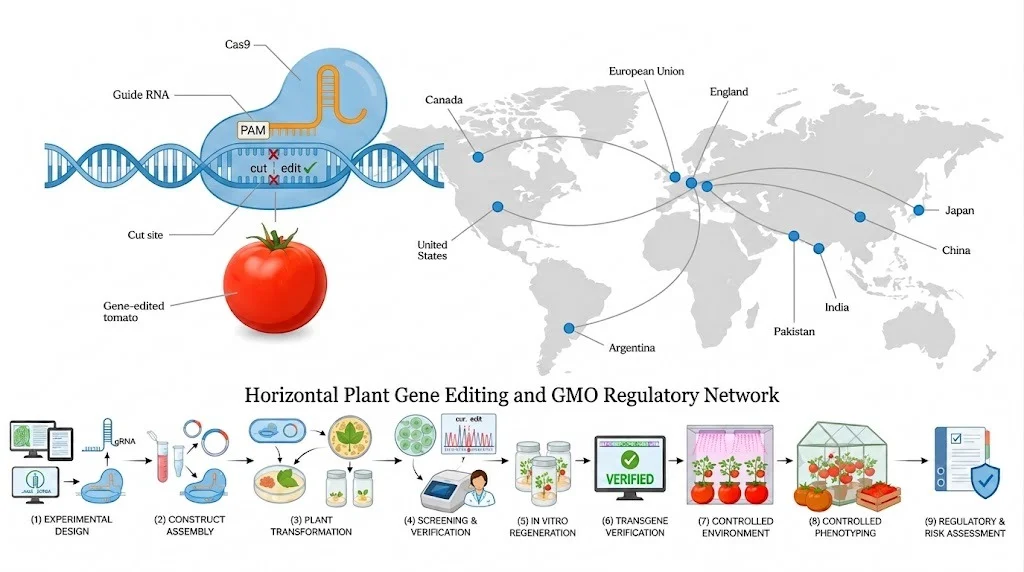 Figure 1. Global landscape of CRISPR-Cas9 plant gene editing and the multi-step regulatory and risk assessment network from experimental design to commercial release.
The Central Question: Is Regulation Based on the Process or the Product?
At the heart of the global debate is a relatively simple question: Should regulators focus on how a crop was developed or on the characteristics of the final plant? These two approaches have shaped much of the international discussion.
| Regulatory Approach | Main Question | What It Means |
|---|---|---|
| Process-based regulation | How was the organism developed? | The use of genetic engineering can trigger GMO regulation, even if the final genetic change is small. |
| Product-based regulation | What genetic characteristics does the final organism have? | A crop may receive less stringent treatment if its genetic changes could also occur through conventional breeding and it meets the relevant criteria. |
A process-based system places greater emphasis on the technology used during development. A product-based system focuses more heavily on the resulting genetic characteristics and associated risks. Neither approach automatically guarantees that a crop is safe or unsafe. Both require appropriate consideration of potential risks, although they differ in how regulatory oversight is triggered. This distinction explains why a CRISPR-edited crop may be treated differently across international markets.
Categories of Genome-Edited Crops
Scientists usually sort edits into three groups, and regulators often follow the same logic:
| Type | What Happens | Typical Regulatory Treatment |
|---|---|---|
| SDN-1 (Site-Directed Nuclease 1) | The cell repairs a DNA break on its own (NHEJ), creating a small mutation or indel | Often treated like conventional breeding if no foreign DNA remains |
| SDN-2 (Site-Directed Nuclease 2) | A small, template-guided change (for example, swapping one base pair) | Often treated similarly to SDN-1, though some systems look closer |
| SDN-3 (Site-Directed Nuclease 3) | A new gene or large piece of DNA is inserted | Usually regulated as a traditional GMO / transgenic crop |
The key factor is whether foreign DNA ends up in the final plant. If the editing tools are bred out and nothing foreign remains, many regulators treat the result very differently from a transgenic crop.
A Global Overview: How Different Countries Regulate Gene-Edited Crops
There is no single international regulatory framework for genome-edited crops. Instead, countries have developed different approaches based on their existing biosafety legislation, scientific priorities, agricultural policies, and public attitudes.
| Region | Status of Gene-Edited Crops (as of late 2026) |
|---|---|
| European Union | A new regulation (EU) 2026/1388 was adopted on 17 June 2026 and applies from 17 July 2028, replacing the old situation in which all NGT plants were regulated as GMOs. |
| United States | A patchwork. A federal court vacated USDA’s 2020 SECURE rule in December 2024, and USDA has sought comments on a future framework. |
| England | The Precision Breeding Regulations 2025 came into force on 13 November 2025; qualifying plants are not treated as GMOs. |
| Japan | Japan excludes simple edits without foreign DNA through a notification system. |
| China | A middle ground: streamlined rules for crops without foreign DNA, but testing and a biosafety certificate are still required. |
| India | SDN-1 and SDN-2 edits without foreign DNA are exempt from the GMO framework, following a 2022 clarification. |
| Pakistan | In transition. Gene-edited organisms were historically classified as GMOs under the Pakistan Biosafety Rules 2005 (amended 2024), but 2026 amendments formally recognize advanced gene editing technologies. |
| Argentina | The first country to adopt a dedicated regulation, in 2015, using a case-by-case preliminary decision. |
| Canada | A product-based approach: oversight is triggered only when a novel trait is introduced, whatever the technique. |
European Union: A New Direction for Genome Editing
For years, the European Union maintained one of the more restrictive approaches to gene-edited crops. Following a 2018 ruling by the Court of Justice of the European Union, organisms produced through certain newer mutagenesis techniques were generally brought within the existing GMO legislation. This created regulatory challenges for researchers and plant breeders working with CRISPR and other precision-editing technologies.
However, the situation changed in June 2026. The European Parliament and Council adopted Regulation (EU) 2026/1388, establishing a dedicated framework for certain plants developed using new genomic techniques (NGTs).
The regulation introduces two main categories:
- Category 1 NGT plants: Plants considered equivalent to conventionally bred plants when they meet specified genetic criteria. These plants are subject to a verification process rather than the full GMO authorisation system.
- Category 2 NGT plants: Plants that do not meet the equivalence criteria and remain subject to more extensive authorisation and regulatory requirements.
The legislation includes specific limits on genetic changes. For example, qualifying targeted mutagenesis plants can contain substitutions or insertions of no more than 20 nucleotides, alongside other defined conditions. There are also important limitations concerning labelling, organic production, and patent transparency.
One detail is particularly important: although the regulation entered into force in July 2026, its main provisions will apply from 17 July 2028. Until then, the existing GMO rules continue to apply to the relevant NGT plants and products. This means the EU is moving towards a more differentiated regulatory system, but the transition is not yet complete.
United States: A Regulatory Framework in Transition
The United States has traditionally taken a more product-focused approach to agricultural biotechnology, although its regulatory system involves multiple agencies. The USDA, FDA, and EPA have different responsibilities depending on the characteristics and intended use of the organism or product.
In 2020, the USDA introduced its SECURE rule, which revised the regulatory framework for certain organisms developed using genetic engineering. However, an important legal development occurred on 2 December 2024, when a US federal court vacated the SECURE rule. Following this decision, the USDA’s Animal and Plant Health Inspection Service (APHIS) resumed relevant regulatory processes under the earlier biotechnology regulations.
As of 2026, the United States continues to operate under this earlier framework while considering potential regulatory revisions. For developers of CRISPR-edited crops, this means that regulatory status should not be assumed simply because an edit is small or foreign DNA is absent. The particular organism, modification, and applicable regulatory requirements must be evaluated. The US system remains an important example of how legal decisions can influence the direction of agricultural biotechnology regulation.
England: Recognition of Precision Breeding
England has taken a distinct legislative route through the Genetic Technology (Precision Breeding) Act 2023. The legislation establishes a separate framework for qualifying precision-bred organisms, including certain plants developed using modern biotechnology.
The main principle is that a plant can qualify as precision-bred if its genetic characteristics could also have been produced through traditional breeding processes. The relevant provisions for precision-bred plants came into force on 13 November 2025. Under this system, qualifying plants can follow a streamlined regulatory route separate from conventional GMOs.
However, this does not mean that every CRISPR-edited crop is automatically exempt from regulation. Plants must meet the relevant scientific criteria and comply with applicable notification, release, marketing, and food and feed requirements. It is also important to remember that this framework applies to England, not automatically to Scotland, Wales, or Northern Ireland.
Japan: A Notification-Based Approach
Japan has adopted a relatively flexible approach towards certain genome-edited foods. Under its existing framework, some products developed through genome editing can follow a notification process rather than the full safety assessment required for conventional recombinant DNA-derived foods.
This generally applies when the genetic modification does not leave foreign genes or their parts in the final product and the relevant regulatory conditions are satisfied. Developers are expected to provide information about the editing process, the resulting genetic changes, and evidence concerning the absence of remaining foreign DNA where applicable.
This distinction is important because a genome-edited product containing introduced foreign genetic material may fall under a different regulatory pathway. Japan’s approach illustrates how regulators can distinguish between certain genome-editing outcomes and traditional transgenic products without abandoning biosafety oversight.
China: Supporting Innovation Through Biosafety Evaluation
China is an important player in agricultural biotechnology and has increasingly incorporated genome-editing technologies into its agricultural research and development programmes. The Ministry of Agriculture and Rural Affairs introduced guidelines for the safety evaluation of gene-edited plants in 2022.
These guidelines provide a regulatory pathway for the evaluation of gene-edited plants, including requirements concerning the genetic changes, molecular characteristics, environmental safety, and other relevant information. Rather than treating every genome-edited plant identically, the framework provides a specific evaluation route based on the characteristics of the edited organism.
However, it would be inaccurate to describe China as having a completely deregulated system for gene-edited crops. Developers must still comply with the relevant biosafety requirements and obtain the necessary approvals. China’s approach reflects an effort to encourage agricultural innovation while maintaining regulatory oversight.
India: Exemptions for Certain Gene-Edited Plants
India has made significant progress in establishing a regulatory framework for genome-edited crops. An important development occurred in March 2022, when the Ministry of Environment, Forest and Climate Change exempted qualifying SDN-1 and SDN-2 genome-edited plants from specified provisions of the Rules, 1989, under the Environment (Protection) Act, 1986.
The exemption applies to plants that are free from exogenously introduced DNA. India subsequently introduced the Guidelines for the Safety Assessment of Genome Edited Plants, 2022, and standard operating procedures for regulatory review of qualifying SDN-1 and SDN-2 plants.
This is an important distinction: exemption from specified GMO provisions does not mean that these crops are free from all regulatory requirements. Their further development, evaluation, and release as new varieties or hybrids remain subject to other applicable laws and procedures. India’s framework is particularly relevant to agricultural researchers because it creates a clearer regulatory pathway for certain precision-edited crops.
Pakistan: A Developing Regulatory Landscape
Pakistan deserves particular attention because agriculture plays a major role in its economy, and modern biotechnology could contribute to improving crop productivity, disease resistance, and environmental resilience.
The country’s biosafety framework is primarily based on the Pakistan Biosafety Rules and Guidelines, originally introduced in 2005 and subsequently amended in 2024. Under this framework, genetically engineered organisms are subject to biosafety oversight, including the involvement of institutional biosafety committees and the National Biosafety Committee.
The National Agricultural Biotechnology Policy 2025 also discusses the regulatory position of gene-edited organisms and identifies the need for a clearer approach to emerging genome-editing technologies. However, it is important to distinguish policy discussions from legally implemented regulatory changes.
During 2026, discussions continued regarding the strengthening of Pakistan’s national biosafety framework. A technical working group meeting held in August 2026 focused on identifying gaps in the existing rules and guidelines and developing a roadmap for further revisions. This indicates that Pakistan’s regulatory system is still evolving. It would therefore be premature to assume that all SDN-1 and SDN-2 crops without foreign DNA are automatically exempt from GMO regulations. For Pakistani researchers and agricultural biotechnology companies, the priority should be to follow the latest official requirements issued by the relevant national biosafety authorities.
The Challenge of Detection and Global Trade
Here is the part that surprises many people: a traditional transgenic crop can be readily identified in the laboratory by the presence of a foreign promoter or marker gene. But a transgene-free gene-edited crop cannot be distinguished from a conventional crop, because the mutation looks identical to one that could occur naturally through spontaneous mutation.
That makes enforcement, traceability, and identity preservation difficult, especially when a crop crosses a border where regulatory definitions diverge. It also means a shipment that is completely legal in one market could, in principle, raise regulatory questions or face import rejections in another, which is a vital consideration for agricultural exporters like Pakistan.
The Debate: Process vs. Product
Reasonable people disagree on how best to regulate these technologies, and it helps to hear both perspectives at their strongest:
Arguments for Lighter (Product-Based) Regulation:
- Trait-focused risk: The risk comes from the expressed trait and the final product, not the breeding tool used.
- Natural equivalents: Small edits mimic changes that arise naturally or through conventional chemical and radiation mutation breeding.
- Democratizing innovation: Heavy regulatory burdens slow innovation and favor large multinational corporations, as smaller academic laboratories and public breeders cannot afford multi-million dollar regulatory dossiers.
- Climate resilience: Faster, precision-breeding tools are urgently needed to develop crops adapted to climate change, drought, salinity, and emerging pathogens.
Arguments for Precaution and Regulatory Oversight:
- Off-target and unintended effects: Edited plants can still undergo unintended genetic alterations or pleiotropic effects, warranting proportionate case-by-case review.
- Consumer transparency: Consumers should have clear information and the right to choose, including through appropriate labelling frameworks.
- Market concentration and patents: Broad patent portfolios raise concerns about corporate control over foundational crop germplasm.
- Preserving organic standards: Organic and non-GMO supply chains require clear rules and traceability to maintain consumer trust.
Most modern frameworks attempt to find a pragmatic middle ground, and the ongoing international discussion centers on where and how to draw that line.
The Future of Gene-Edited Crops
Genome-editing regulations will continue to evolve over the coming years. Several key developments deserve close attention:
- EU Implementation: The European Commission is preparing delegated and implementing acts, which will determine how Category 1 verification and Category 2 applications operate in practice before the rules apply in 2028.
- US Rulemaking: The USDA’s forthcoming post-SECURE framework will clarify whether the United States moves toward a fully product-based system.
- Pakistan’s Implementation: How the 2026 amendments and updated biosafety guidelines treat different edit types, and how quickly gene-edited varieties can transition from containment to field trials.
- International Trade Alignment: As more countries adopt differing rules, pressure will mount in international bodies (such as the WTO and Codex Alimentarius) for harmonized definitions and mutual recognition agreements.
Key Takeaways
- “Is it a GMO?” has no single global answer. The classification depends heavily on the jurisdiction and the specific molecular type of edit (SDN-1, SDN-2, or SDN-3).
- The central dividing line is process vs. product, and whether foreign DNA remains in the final cultivar.
- Tiered approaches are becoming common: The EU, England, Japan, India, and China have all moved toward tiered or product-based treatment for transgene-free edits, though procedural details differ significantly.
- The US framework is being rebuilt, and Pakistan is transitioning from GMO-by-default rules toward formal statutory recognition of precision gene editing.
- Regulatory landscapes are dynamic: Researchers, developers, and exporters should always verify the latest official gazetted text before commercializing or shipping gene-edited varieties.