- 1 Introduction
- 2 Conventional CRISPR-Cas9 Gene Editing
- 3 Base Editing
- 4 How Does Base Editing Work?
- 5 The Two Major Types of Base Editing
- 6 CRISPR-Cas9 vs. Base Editing: What Is the Actual Difference?
- 7 Why Does Avoiding Double-Strand Breaks Matter?
- 8 Other Challenges of Base Editing
- 9 Where Can Base Editing Be Used?
- 10 Base Editing vs. Prime Editing: Are They the Same?
- 11 Final Thoughts
Introduction
For years, CRISPR-Cas9 has been one of the most powerful tools in molecular biology. It allows scientists to target specific DNA sequences, modify genes, and investigate the genetic mechanisms responsible for different diseases. However, there is one important limitation: conventional CRISPR-Cas9 works by cutting both strands of DNA. Although this ability makes gene editing possible, introducing a double-strand break also creates new challenges. Once DNA is cut, the cell must activate its natural repair machinery to restore the damaged genetic material. Sometimes this repair process produces unexpected insertions, deletions, or other genetic changes. But what if scientists could modify a specific DNA letter without cutting both strands? This is exactly the idea behind base editing.
Instead of creating a conventional double-strand break, base editors use specialized enzymes to chemically convert one DNA base into another at a targeted location. This approach has opened new possibilities for correcting genetic mutations, particularly those caused by single-nucleotide changes. The technology is also changing how researchers think about precision medicine. Rather than relying entirely on DNA cutting and repair, scientists can now explore ways to directly rewrite individual genetic letters. So, how does base editing work? How is it different from conventional CRISPR-Cas9? And why does avoiding double-strand breaks matter for the future of gene therapy? Let’s explore.
Conventional CRISPR-Cas9 Gene Editing
Before understanding base editing, it is important to understand how conventional CRISPR-Cas9 works. CRISPR-Cas9 is a genome-editing system adapted from a natural bacterial defense mechanism. In bacteria, CRISPR-associated systems help recognize and defend against invading genetic material, such as bacteriophage DNA. Scientists adapted this biological mechanism to modify specific regions of the genomes of living organisms.
The system mainly relies on two important components:
- Cas9 enzyme: A molecular nuclease that cuts DNA.
- Guide RNA (gRNA): A programmable RNA molecule that directs Cas9 toward a selected DNA sequence.
When the guide RNA recognizes its complementary target sequence, Cas9 binds to the DNA and introduces a double-strand break near the target site. However, cutting DNA is only the beginning of the editing process. After the break occurs, the cell activates its natural DNA repair pathways. Two important pathways are non-homologous end joining (NHEJ) and homology-directed repair (HDR).
Non-homologous end joining (NHEJ) reconnects the broken DNA ends. Although this pathway is relatively efficient, it can introduce small insertions or deletions, commonly called indels. These changes can disrupt a gene’s normal reading frame or interfere with its function. This is why conventional CRISPR-Cas9 is frequently used for gene knockout experiments.
Homology-directed repair (HDR) uses a homologous DNA sequence as a template to repair the break. When researchers provide an appropriate donor DNA template, HDR can introduce a desired genetic modification. However, HDR efficiency can be limited, particularly in non-dividing cells.
This creates an important limitation. Conventional CRISPR-Cas9 is excellent for disrupting genes and introducing certain genetic modifications, but correcting a single DNA letter without producing unwanted changes can be more challenging. And this is where base editing enters the picture.
Base Editing
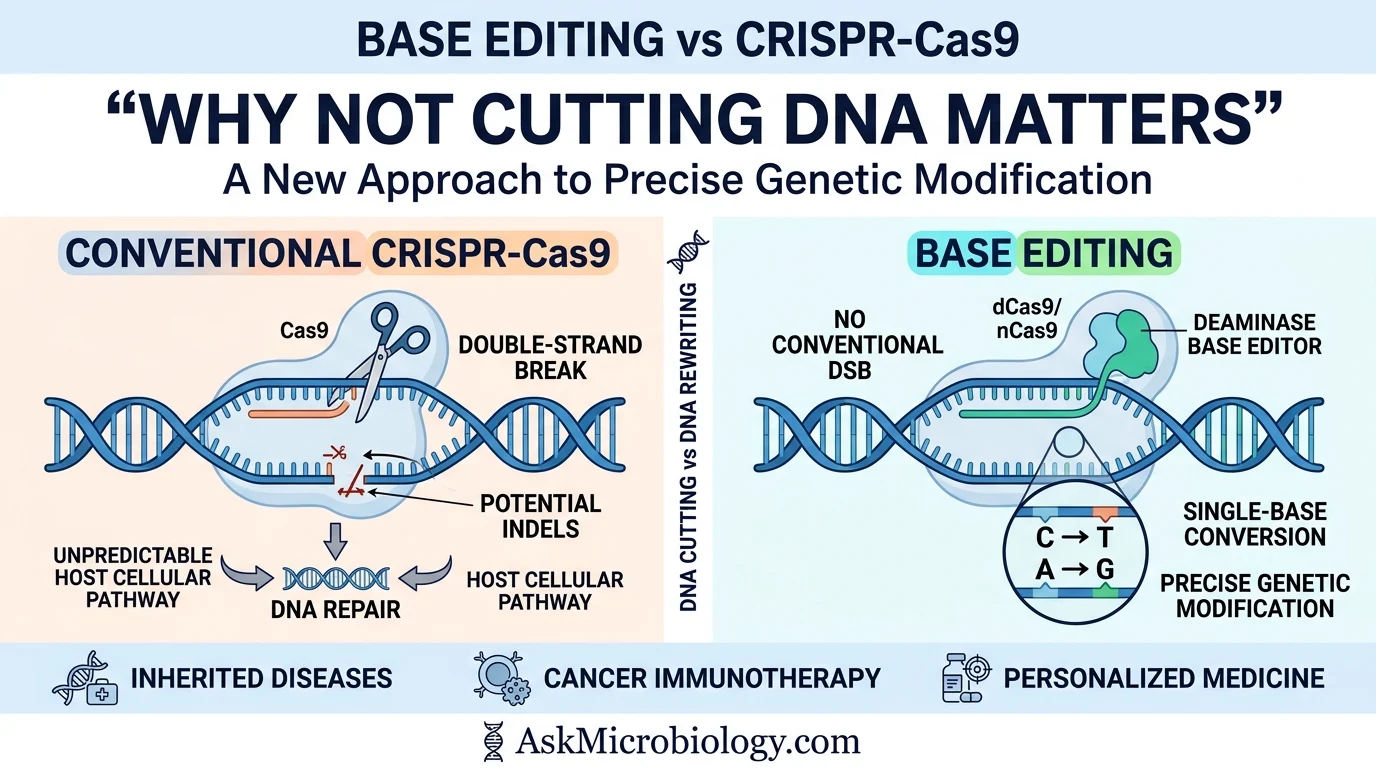
Base editing is a CRISPR-derived genome-editing technology that allows scientists to convert one DNA base into another without introducing a conventional double-strand break. Instead of relying on Cas9 to cut both DNA strands, base editors combine a modified Cas protein with a specialized enzyme called a deaminase. The Cas protein helps locate the target DNA sequence, while the deaminase performs the chemical modification. In simple terms, conventional CRISPR-Cas9 acts like molecular scissors, whereas base editing works more like a molecular pencil that changes a specific letter in the genetic code.
For example, imagine that a genetic mutation changes a cytosine (C) into a thymine (T), disrupting the function of an important protein. If the mutation is suitable for base editing, researchers may be able to reverse that change without creating a conventional double-strand break. This is particularly interesting because single-nucleotide variants are responsible for many inherited genetic disorders. Base editing is therefore being investigated as a potential treatment strategy for diseases caused by specific point mutations.
How Does Base Editing Work?
Although the concept sounds simple, base editing involves several molecular steps. Unlike conventional Cas9 editing, the system does not depend on cutting both DNA strands and waiting for the cell to repair the break. Instead, it uses a modified CRISPR protein and a DNA-modifying enzyme to change a specific nucleotide. The process generally involves four steps.
Guide RNA Recognizes the Target DNA
The first step is similar to conventional CRISPR-Cas9. Researchers design a guide RNA that recognizes a specific DNA sequence near the mutation they want to modify. The guide RNA directs the base-editing complex toward the selected genomic location. However, the target sequence must also satisfy the requirements of the Cas protein, including the presence of a suitable protospacer adjacent motif (PAM).
Modified Cas9 Binds to the DNA
Instead of using a fully active Cas9 nuclease, base editors generally use a Cas9 nickase or a catalytically inactive Cas protein. A Cas9 nickase cuts only one DNA strand, while catalytically inactive Cas9 can bind DNA without cutting it. When the Cas protein binds to the target, a small region of DNA becomes temporarily unwound, creating a single-stranded DNA region called an R-loop. This exposed DNA provides access for the attached deaminase enzyme.
Deaminase Modifies the Target Base
This is the most important step in base editing. The deaminase enzyme chemically modifies a specific nucleotide within the exposed DNA region.
Two major classes of base editors are commonly used:
- Cytosine base editors (CBEs): Cytosine base editors convert cytosine into uracil through a deamination reaction. The cellular repair and replication machinery subsequently helps establish the intended C-to-T base-pair conversion.
- Adenine base editors (ABEs): Adenine base editors convert adenine into inosine. Because inosine is interpreted similarly to guanine during DNA processing, the final outcome is generally an A-to-G base-pair conversion.
These two systems allow researchers to introduce specific types of nucleotide substitutions without requiring a conventional double-strand break.
Cellular Repair Machinery Completes the Modification
After the deaminase modifies the target nucleotide, the cell’s natural DNA processing mechanisms help establish the desired base-pair change. In many commonly used base editors, the Cas9 nickase introduces a single-strand nick in the opposite, unedited DNA strand. This encourages cellular repair mechanisms to use the edited strand as a template. Eventually, the intended nucleotide conversion becomes incorporated into the DNA sequence. The important difference is that the process avoids the conventional double-strand break created by fully active Cas9.
The Two Major Types of Base Editing
Although both cytosine and adenine base editors use a similar overall strategy, they perform different nucleotide conversions.
Cytosine Base Editing (CBE)
Cytosine base editors were among the first widely developed base-editing systems. They generally combine a Cas9 nickase with a cytidine deaminase enzyme. The deaminase converts cytosine into uracil within the exposed DNA region. Following DNA processing, the intended C•G base pair is converted into T•A. This approach is particularly useful when researchers need to correct mutations involving C-to-T or complementary G-to-A changes, depending on which DNA strand is targeted.
Adenine Base Editing (ABE)
Adenine base editors use an engineered adenosine deaminase to convert adenine into inosine. The cellular machinery subsequently interprets inosine as guanine, resulting in an A•T-to-G•C conversion. ABEs are particularly valuable because many disease-associated mutations involve adenine-to-guanine or complementary thymine-to-cytosine changes. Together, CBEs and ABEs have significantly expanded the range of genetic modifications that can be performed without conventional DNA double-strand breaks. However, they cannot correct every possible mutation. Their editing capabilities depend on the type of nucleotide conversion required.
CRISPR-Cas9 vs. Base Editing: What Is the Actual Difference?
Both technologies use programmable CRISPR components to recognize specific DNA sequences, but their editing mechanisms are quite different.
The biggest difference is not simply that one technology is newer than the other. It is that conventional CRISPR-Cas9 relies on DNA cleavage followed by cellular repair, whereas base editing directly modifies selected nucleotides through enzymatic chemistry. This difference can influence the types of mutations produced and the risks associated with the editing process.
| Feature | Conventional CRISPR-Cas9 | Base Editing |
|---|---|---|
| Main components | Cas9 and guide RNA | Modified Cas protein, deaminase and guide RNA |
| DNA modification | Double-strand break | Chemical modification of a nucleotide |
| Double-strand break | Yes | No conventional DSB |
| Single-strand nick | Not required | Common in many base editors |
| DNA repair | NHEJ or HDR | Cellular processing of modified bases |
| Main application | Gene knockout, insertion and deletion | Specific nucleotide substitutions |
| Donor DNA | Needed for many precise HDR edits | Generally not required |
| Main limitation | Repair-related unwanted changes | Editing window and bystander changes |
Why Does Avoiding Double-Strand Breaks Matter?
This is probably the most important question in understanding the development of base editing. DNA double-strand breaks are not necessarily harmful in every situation. Cells naturally experience DNA damage and have repair systems designed to deal with it. However, deliberately introducing double-strand breaks into the genome can create additional risks.
Fewer Unwanted Insertions and Deletions
When conventional Cas9 cuts DNA, the cell must reconnect the broken strands. During this process, small insertions or deletions can occur. Although these changes are useful for gene knockout experiments, they may be undesirable when researchers want to correct a specific mutation. Base editing avoids the conventional double-strand break, which can substantially reduce the formation of indel byproducts at the target site.
Reduced Risk of Large Genomic Rearrangements
One concern associated with conventional CRISPR-Cas9 is that DNA double-strand breaks can occasionally produce larger genomic alterations. These may include large deletions, chromosomal rearrangements, or other structural changes. Because base editing generally avoids conventional double-strand breaks, it can reduce some of the risks associated with break-induced genomic damage. However, base editors still require careful assessment for unintended DNA and RNA modifications.
Less Dependence on Homology-Directed Repair
Precise genetic correction using conventional Cas9 frequently relies on HDR and an appropriate donor DNA template. Unfortunately, HDR is not equally efficient in all cell types and is often less active in non-dividing cells. Base editing does not generally require donor DNA or HDR to introduce its intended nucleotide substitutions. This makes it particularly attractive for applications involving cells that divide slowly or do not divide at all.
More Direct Correction of Point Mutations
When a disease is caused by a specific single-nucleotide mutation, researchers may not need to replace an entire gene. They may only need to change one nucleotide. Base editing provides a direct approach for making certain single-base substitutions, making it a promising strategy for investigating and potentially treating genetic disorders caused by suitable point mutations.
Other Challenges of Base Editing
Avoiding double-strand breaks is a major advantage, but it does not mean that base editing is completely risk-free. Several challenges still need to be addressed.
- Off-target editing: Base editors may sometimes modify DNA sequences outside the intended target region. Some deaminases can also produce unintended RNA modifications.
- Bystander editing: Multiple compatible nucleotides within the editing window may be modified, even when only one change is intended.
- Delivery difficulties: Base editors are relatively large molecular systems. Delivering all required components into the correct cells, particularly inside the human body, remains challenging.
- Limited editing compatibility: Existing CBEs and ABEs cannot perform every possible nucleotide substitution. Some mutations require alternative technologies such as prime editing.
- Long-term safety: Because base editing can permanently modify DNA, researchers must investigate genomic stability, unintended mutations, immune responses, and long-term biological effects.
These limitations explain why improving editing precision and developing better delivery systems remain important priorities in the field.
Where Can Base Editing Be Used?
Base editing is attracting attention in several areas of biotechnology and medicine, particularly where changing a specific DNA nucleotide can produce a meaningful biological effect.
Inherited Genetic Disorders
Many inherited diseases are caused by single-nucleotide mutations that alter protein function. If the disease-associated mutation is compatible with available base-editing chemistry, researchers may be able to correct it directly. Researchers are also investigating base-editing approaches for sickle cell disease and beta-thalassemia. One strategy involves modifying the erythroid-specific regulatory region of BCL11A to increase fetal hemoglobin production rather than directly correcting the disease-causing hemoglobin mutation.
Cancer Research and CAR-T Cell Engineering
Base editing is also becoming an interesting tool in cancer immunotherapy research. Scientists can use it to modify immune cells and investigate how specific genes influence T-cell activity, immune recognition, and resistance to suppressive tumor environments. For example, researchers are exploring base-editing strategies to modify multiple genes in therapeutic T cells used in adoptive cell therapies. This may eventually help develop more sophisticated CAR-T cells, although editing multiple genes at once still requires careful testing for safety and efficiency.
Functional Genomics and Personalized Medicine
Base editing is not limited to clinical treatment. It is also useful for studying how individual DNA changes influence gene expression, protein activity, and cellular signaling. By introducing specific nucleotide substitutions, researchers can investigate whether a particular genetic variant is responsible for a disease-associated phenotype. This creates an important connection with personalized medicine. If a patient’s condition is caused by a suitable point mutation, scientists may be able to design a therapeutic editing strategy specifically for that genetic alteration.
Base Editing vs. Prime Editing: Are They the Same?
Although base editing and prime editing are both advanced CRISPR-derived technologies, they solve somewhat different problems. Base editing is designed mainly for specific nucleotide substitutions. Prime editing offers greater flexibility because it can introduce a wider range of DNA changes, including all 12 possible base substitutions and certain small insertions and deletions. The main components of prime editing include a Cas9 nickase fused to reverse transcriptase and a specialized guide RNA called a prime editing guide RNA (pegRNA). The pegRNA contains both the targeting sequence and the information needed to introduce the desired genetic change. Unlike conventional Cas9 editing, prime editing does not require a conventional double-strand break or an external donor DNA template. However, prime editing has its own limitations, including complex guide design, delivery challenges, and variable editing efficiency.
In simple terms, base editing is particularly useful when the desired change matches its available nucleotide-conversion chemistry. Prime editing becomes interesting when the required genetic modification falls outside those restrictions.
| Feature | Base Editing | Prime Editing |
|---|---|---|
| Main components | Cas protein and deaminase | Cas9 nickase and reverse transcriptase |
| Double-strand break | No | No conventional DSB |
| Base substitutions | Specific compatible conversions | All 12 base substitutions |
| Small insertions/deletions | Not generally supported | Supported within size limitations |
| Donor DNA | Not required | Not required |
| Main limitation | Restricted editing chemistry and window | Complex design and variable efficiency |
Final Thoughts
The development of base editing represents an important shift in the way scientists approach genome engineering. Conventional CRISPR-Cas9 introduced a powerful method for cutting DNA at specific locations, allowing researchers to disrupt genes and introduce genetic modifications through cellular repair pathways. Base editing takes a different approach by directly converting selected DNA bases without creating conventional double-strand breaks. This can reduce certain unwanted repair outcomes and offers an attractive strategy for correcting specific point mutations. However, the technology still has limitations, including restricted nucleotide conversions, bystander editing, off-target activity, and delivery challenges. The real significance of base editing is not that it makes conventional CRISPR-Cas9 obsolete. Instead, it expands the genome-editing toolkit. Sometimes researchers need to remove an entire gene. Sometimes they need to insert a new DNA sequence. But in other situations, the problem is simply one incorrect letter in the genetic code. And when changing that single letter is enough, cutting both strands of DNA may no longer be necessary.