- 1 Introduction
- 2 Personalized Gene Therapy
- 3 Why Would Someone Need a Drug Designed Specifically for Them?
- 4 Working of Personalized Gene Therapy
- 5 A Real-Life Example: The Baby Who Received a Personalized CRISPR Treatment
- 6 Why Is Personalized Gene Therapy So Exciting?
- 7 The Problem: Why Is Making a Drug for One Patient So Difficult?
- 8 Can Personalized Gene Therapy Become More Affordable?
- 9 Personalized Gene Therapy vs. Conventional Gene Therapy
- 10 What Does the Future Hold?
- 11 Final Thoughts
Introduction
For decades, drug development has followed a relatively straightforward idea: develop a medicine for a disease, test it in clinical trials, and make it available to patients who have that condition. Although this approach has transformed modern medicine, it does not work equally well for everyone. Some patients have genetic conditions so rare that only a handful of people worldwide share the same mutation. Others carry unusual genetic variants that do not respond to existing treatments. In these situations, developing a conventional drug for a large patient population becomes extremely difficult. But what if scientists could design a treatment specifically for one individual?
This is the idea behind personalized gene therapy. Instead of developing one treatment for thousands of patients, researchers can use an individual’s genetic information to create a therapeutic strategy tailored to their specific disease-causing mutation. It sounds almost futuristic, but this approach is already becoming a reality. Advances in genome sequencing, CRISPR gene editing, antisense oligonucleotides (ASOs), and RNA-based therapeutics are making it possible to develop treatments for patients who previously had very few options. However, there is another side to this exciting development. Creating a drug for one patient can be scientifically complicated, extremely expensive, difficult to regulate, and challenging to manufacture. So, is personalized gene therapy the future of medicine, or are we moving toward a treatment strategy that only a small number of patients can actually afford? Let’s explore.
Personalized Gene Therapy
Personalized gene therapy refers to therapeutic approaches designed around an individual’s genetic characteristics, particularly when a specific genetic alteration is responsible for their disease. Unlike conventional treatments that target a disease shared by many patients, personalized approaches may be developed to address a particular mutation or molecular abnormality in an individual. For example, imagine two patients diagnosed with the same inherited genetic disorder. Although their clinical symptoms may appear similar, genetic sequencing reveals that they carry two completely different mutations in the same gene.
A conventional treatment may work for both patients, but a mutation-specific treatment might only be suitable for one of them. Personalized gene therapy attempts to address this difference by designing an intervention based on the patient’s actual genetic information. Depending on the disease, the treatment may involve correcting a DNA mutation, modifying gene expression, replacing a defective gene, or targeting an abnormal RNA molecule. It is important to understand that personalized medicine and truly individualized gene therapy are not exactly the same. Personalized medicine can involve selecting an existing drug based on a patient’s genetic profile. Truly individualized or N-of-1 therapy goes further by developing or modifying the therapeutic product specifically for one patient or a very small number of patients. This distinction becomes particularly important when discussing ultra-rare genetic diseases.
Why Would Someone Need a Drug Designed Specifically for Them?
To understand the need for personalized therapies, we first need to look at the problem of genetic variation. Human DNA contains millions of genetic differences. Most are harmless, but some can interfere with normal protein production, cellular signaling, metabolism, or other essential biological processes. In inherited diseases, a single mutation can sometimes disrupt an important protein and produce severe clinical consequences. The difficulty is that not all mutations behave in the same way.
For example, a mutation may:
- Introduce a premature stop codon into a gene.
- Change one amino acid in an important protein.
- Disrupt normal RNA splicing.
- Prevent proper protein folding.
- Reduce or completely eliminate gene expression.
- Cause a protein to become abnormally active.
Although these mutations may affect the same gene, they do not necessarily respond to the same treatment. This is why a treatment developed for one genetic variant may not work for another. In addition, some rare diseases affect such a small number of people that pharmaceutical companies have little commercial incentive to develop conventional treatments for them. For patients with these conditions, a personalized therapeutic approach may be the only realistic opportunity to target the underlying genetic problem.
Working of Personalized Gene Therapy
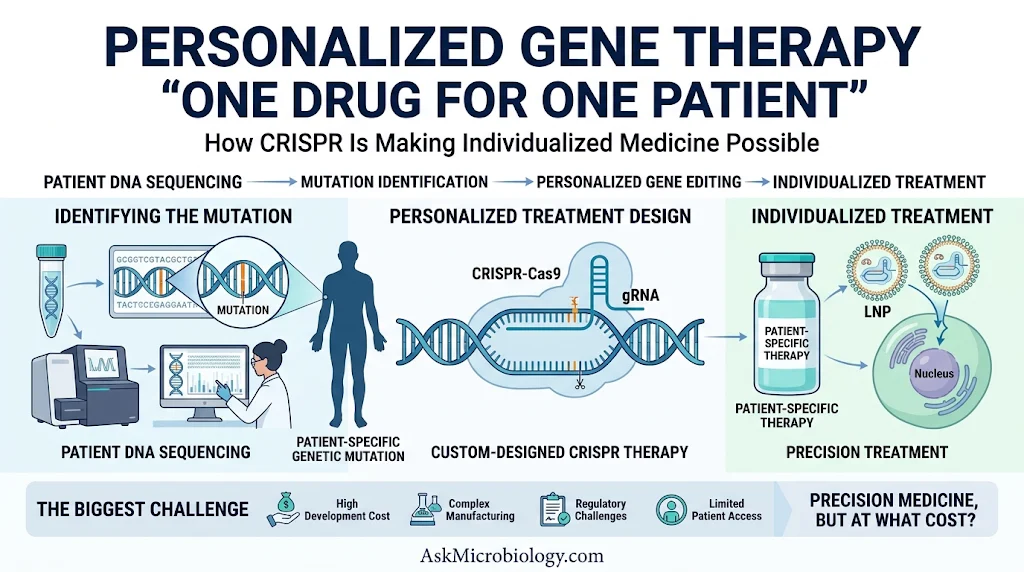
Developing a personalized genetic treatment involves several interconnected stages. The process begins with understanding the patient’s genetic information and ends with delivering a treatment designed around the identified abnormality.
Genetic Sequencing and Mutation Identification
The first step is identifying the genetic alteration responsible for the disease. Researchers and clinicians may use whole-genome sequencing, whole-exome sequencing, or targeted genetic panels to investigate the patient’s DNA. Once a potentially disease-causing variant is identified, scientists evaluate whether it is actually responsible for the patient’s clinical condition. This is important because not every genetic difference detected during sequencing is harmful. Researchers must consider the variant’s location, predicted biological effect, inheritance pattern, clinical presentation, and available functional evidence.
Understanding the Molecular Mechanism
Identifying a mutation is only the beginning. Scientists must determine how that particular genetic change interferes with normal cellular function. For example, does the mutation prevent a protein from being produced? Does it create an abnormal protein? Does it interfere with RNA processing? The answer determines which therapeutic strategy might be appropriate. A mutation that produces an abnormal RNA transcript may be suitable for an antisense oligonucleotide approach, whereas certain single-nucleotide changes may be candidates for base editing. Without understanding the underlying molecular mechanism, designing an effective treatment becomes much more difficult.
Selecting the Appropriate Therapeutic Technology
After identifying the disease-causing mechanism, researchers select a suitable therapeutic platform. Several technologies are being investigated for individualized genetic medicine:
- CRISPR-Cas9: Uses a guide RNA to direct Cas9 toward a selected DNA sequence, where the enzyme introduces a targeted double-strand break.
- Base editing: Allows researchers to convert one DNA base into another without requiring a conventional double-strand break.
- Prime editing: Combines a modified Cas enzyme with reverse transcriptase and a specialized guide RNA to introduce selected DNA changes.
- Antisense oligonucleotides (ASOs): Short synthetic nucleic acid molecules designed to bind specific RNA sequences and modify processes such as splicing, RNA stability, or translation.
- RNA-based therapies: Can be designed to influence protein production or compensate for certain defects without permanently modifying genomic DNA.
The choice depends on the mutation, the affected tissue, the disease mechanism, and the safety requirements.
Designing and Testing the Personalized Treatment
Once the therapeutic strategy is selected, researchers design the treatment around the patient’s genetic sequence. For a CRISPR-based therapy, this may involve designing a guide RNA that recognizes the specific target sequence. For an ASO-based treatment, scientists design an oligonucleotide that binds the relevant RNA region. The candidate treatment then undergoes laboratory testing using appropriate cellular models. Researchers evaluate whether the treatment produces the intended molecular effect, whether unintended changes occur, and whether the cells maintain acceptable viability and function. Depending on the platform, additional studies may include animal models, toxicology testing, delivery optimization, and off-target analysis.
Manufacturing and Clinical Administration
After sufficient preclinical evaluation and the necessary regulatory authorization, the therapeutic product can be manufactured for the intended patient. This stage requires strict quality control because even a treatment designed for one person must meet appropriate standards for identity, purity, potency, and safety. Once authorized, the treatment is administered under clinical supervision. Researchers then monitor the patient’s clinical response, molecular biomarkers, adverse effects, and long-term outcomes. This final stage is particularly important because a promising laboratory result does not automatically guarantee a successful clinical treatment.
A Real-Life Example: The Baby Who Received a Personalized CRISPR Treatment
One of the most remarkable examples of personalized gene therapy emerged in 2025. An infant known as Baby KJ was diagnosed with a rare metabolic disorder called carbamoyl phosphate synthetase 1 (CPS1) deficiency. This condition affects the urea cycle, a metabolic pathway responsible for converting toxic ammonia into urea so that it can be eliminated from the body. When CPS1 does not function properly, ammonia can accumulate in the bloodstream and cause serious neurological damage and other life-threatening complications. In severe cases, the disease can become critical during infancy. For Baby KJ, conventional treatment options were extremely limited. Researchers at Children’s Hospital of Philadelphia and Penn Medicine therefore developed a customized gene-editing strategy based on his specific genetic mutation. The team used CRISPR base editing rather than conventional Cas9-mediated DNA cutting.
The therapeutic system was designed to correct the patient’s disease-associated genetic variant in liver cells. To deliver the editing components, researchers used lipid nanoparticles containing messenger RNA encoding the base editor and a guide RNA. The nanoparticles helped transport the editing machinery into liver cells, where the genetic modification could take place. The treatment was administered in two infusions in February and March 2025. Early clinical observations were encouraging. Baby KJ was able to tolerate increased dietary protein and a reduction in nitrogen-scavenging medication. No serious adverse events were reported during the initial follow-up period described in the original publication.
A February 2026 update from the hospital reported further developmental progress, including walking and talking. However, longer-term follow-up remains essential to establish the treatment’s durability and safety. This case was important for a simple reason: scientists had developed and administered a gene-editing treatment specifically designed around one patient’s genetic abnormality. It demonstrated that personalized in vivo gene editing could move from a laboratory concept into clinical application. It also raised an important question: if scientists can develop a treatment for one child, could they eventually do the same for thousands of patients with different rare genetic conditions?
Why Is Personalized Gene Therapy So Exciting?
The potential benefits extend far beyond the treatment of a single rare disease.
Treating Diseases That Previously Had No Effective Options
Many rare genetic disorders have no approved treatment that directly addresses their underlying molecular cause. Patients may depend on supportive care, dietary restrictions, medication, or organ transplantation. Personalized genetic therapies offer an opportunity to target the actual biological problem rather than managing its consequences alone.
For families affected by ultra-rare disorders, this possibility can be life-changing.
Targeting the Exact Genetic Mutation
Traditional treatments often target common biological pathways shared by many patients. Personalized gene therapy can go a step further by addressing the specific genetic alteration responsible for an individual’s condition. This is particularly important when different mutations in the same gene produce different molecular effects.
Potential for Long-Lasting Therapeutic Effects
Some gene-editing approaches introduce permanent modifications into cellular DNA. If the targeted cells remain functional and persist over time, the therapeutic effect may also be long-lasting. This creates the possibility of reducing dependence on repeated medication. However, permanent editing also introduces important safety considerations, particularly because unintended genomic changes may persist.
Making Precision Medicine More Practical
Personalized gene therapy brings genomic sequencing and molecular biology closer to clinical treatment. As sequencing becomes more accessible and therapeutic platforms improve, identifying a patient’s genetic abnormality may increasingly lead to a treatment designed around that specific finding. The ultimate goal is to move beyond simply knowing which mutation causes a disease and toward using that information to develop an effective intervention.
The Problem: Why Is Making a Drug for One Patient So Difficult?
Despite its scientific promise, personalized gene therapy faces several challenges. In fact, the same features that make these treatments exciting can also make them difficult to develop and deliver.
The Cost of Developing an Individualized Treatment
Developing a conventional drug requires substantial investment, but the cost can be distributed across a large patient population. Personalized gene therapy creates a different situation. Imagine spending millions of dollars to develop a treatment that will initially be administered to only one patient. The research team still needs to perform genetic analysis, design the therapeutic molecule, conduct laboratory experiments, evaluate safety, manufacture the product, and complete regulatory procedures. Most of these expenses must be covered even when only one individual will receive the treatment. This makes the economic model extremely difficult.
Manufacturing Is Not Easy to Standardize
Every personalized treatment may require a different guide RNA, ASO sequence, or editing strategy. Although some manufacturing processes can be reused, the final therapeutic product may still need individual customization. This creates difficulties in maintaining consistent quality across different products.
Regulatory Approval Becomes More Complicated
Traditional clinical trials are generally designed to evaluate treatments in groups of patients. Researchers compare outcomes between treatment and control groups to determine whether a medicine is safe and effective. But what happens when a treatment is designed for only one patient?
In February 2026, the US Food and Drug Administration issued draft guidance describing a plausible-mechanism framework for developing individualized therapies targeting specific genetic conditions. The FDA also issued draft guidance in October 2026 addressing individualized human genome-editing products, including considerations for applications involving multiple product variants. These developments indicate growing regulatory interest in creating pathways that can accommodate highly individualized treatments.
Off-Target Effects and Long-Term Safety
One of the most important concerns in personalized gene editing is unintended genetic modification. CRISPR systems are designed to recognize specific DNA sequences, but they may sometimes interact with similar sequences elsewhere in the genome. Such off-target editing could potentially disrupt important genes or regulatory regions. The risk becomes particularly important when the treatment introduces permanent genetic changes.
Time Is a Major Problem for Critically Ill Patients
Personalized gene therapy can require months of research, design, testing, manufacturing, and regulatory preparation. For patients with slowly progressing conditions, this development period may be manageable. But for infants and children with severe metabolic disorders or rapidly progressing neurological diseases, waiting several months can be extremely difficult. Regulatory frameworks must develop alongside scientific progress.
Can Personalized Gene Therapy Become More Affordable?
One promising solution is to stop treating every personalized therapy as an entirely new manufacturing process. Instead, researchers are exploring platform-based approaches. The basic idea is simple: standardize as much of the treatment development process as possible and customize only the component that needs to change. For example, a research team may develop a validated lipid nanoparticle formulation, establish a manufacturing process, and create standardized quality-control procedures. When a new patient presents with a different genetic mutation, researchers may only need to redesign the guide RNA or another sequence-specific component. The remaining platform can potentially be reused.
Personalized Gene Therapy vs. Conventional Gene Therapy
Although both approaches involve genetic medicine, they are not necessarily the same.
| Feature | Conventional Gene Therapy | Personalized Gene Therapy |
|---|---|---|
| Target population | Usually a defined patient group | One patient or a small genetically defined group |
| Treatment design | Standardized for a disease or condition | Tailored to specific genetic characteristics |
| Genetic variation | May target a shared disease mechanism | May address an individual mutation |
| Manufacturing | Generally standardized product | May require sequence-specific customization |
| Development cost | Distributed across a larger population | Can be very high per patient |
| Main challenge | Delivery, efficacy, and safety | Customization, cost, manufacturing, and regulation |
It is worth remembering that personalized gene therapy does not always mean creating an entirely new therapeutic platform. A standardized delivery system or editing technology may be reused while the targeting component is customized for each patient.
What Does the Future Hold?
The future of personalized genetic medicine will likely depend on improvements in several interconnected technologies.
- Next-generation sequencing will help researchers identify disease-causing variants more quickly and accurately.
- Artificial intelligence and computational biology may help predict the functional consequences of genetic mutations and accelerate the design of therapeutic molecules.
- CRISPR base editing and prime editing may provide additional options for correcting mutations that are difficult to address using conventional gene-editing approaches.
- Lipid nanoparticles and advanced delivery systems may make it possible to transport therapeutic nucleic acids more efficiently into specific tissues.
- Automated manufacturing platforms could reduce the time and cost required to produce patient-specific therapeutic molecules.
At the same time, regulatory frameworks will need to evolve to accommodate therapies designed for extremely small patient populations without compromising safety. One particularly interesting direction is the development of reusable therapeutic platforms. Instead of starting from zero every time a new patient is identified, researchers could rely on established manufacturing systems, delivery technologies, and analytical methods. This would allow the scientific team to focus more heavily on the genetic component that actually needs to be customized. The long-term objective is not necessarily to create a completely different drug for every person. It is to make individualized treatment development more predictable, repeatable, and accessible.
Final Thoughts
Personalized gene therapy represents one of the most exciting developments in modern biotechnology. For patients with ultra-rare genetic conditions, a treatment designed specifically around their mutation may offer an opportunity that conventional medicine has not been able to provide. The experience of Baby KJ demonstrated that patient-specific CRISPR treatment is no longer just a theoretical possibility. Scientists can now identify an individual genetic abnormality, design an appropriate editing strategy, develop a delivery system, and administer a customized treatment under appropriate clinical and regulatory oversight. However, scientific success is only one part of the challenge. High development costs, complex manufacturing, limited clinical evidence, regulatory uncertainty, and unequal access remain significant obstacles. The real future of personalized gene therapy will depend on whether researchers can turn extraordinary one-patient achievements into repeatable therapeutic platforms. Ultimately, the goal should not be to develop one expensive drug for one patient. It should be to build a scientific and manufacturing system that makes the right treatment possible for every patient whose genetic disease can be addressed.