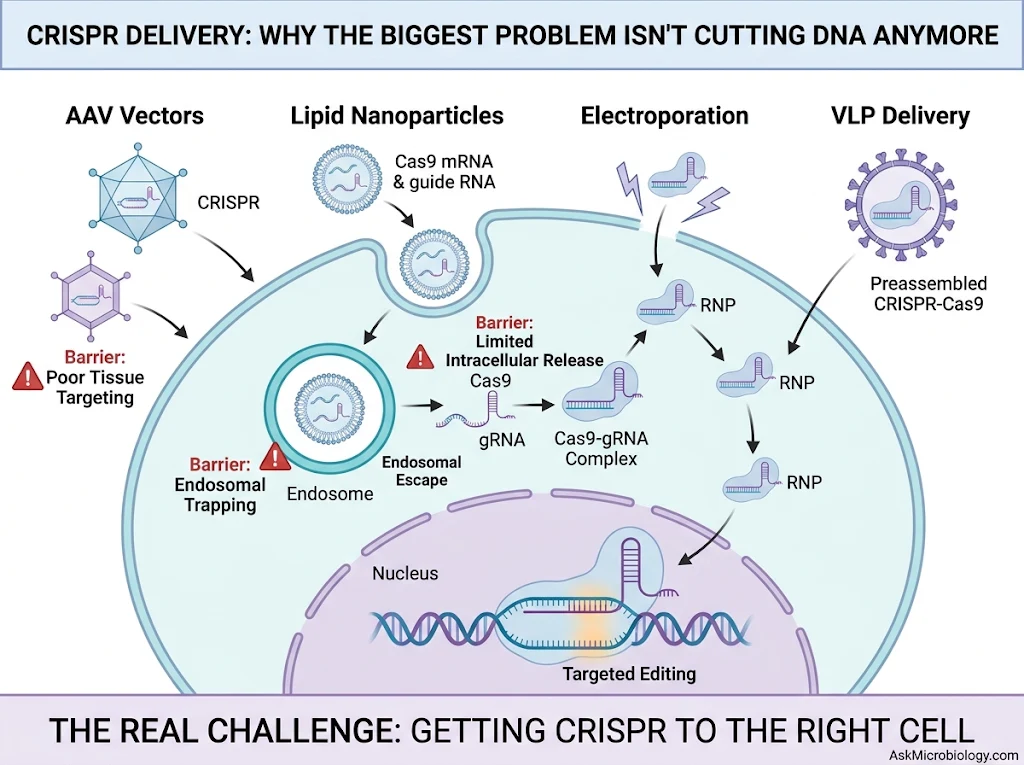
- 1 Why Is CRISPR Delivery Such a Big Problem?
- 2 Understanding the Different Forms of CRISPR Cargo
- 3 Viral Vectors: Using Viruses to Deliver CRISPR
- 4 Lipid Nanoparticles: A Major Breakthrough in CRISPR Delivery
- 5 Electroporation: A Practical Approach for Editing Immune Cells
- 6 Why Getting CRISPR Inside the Cell Is Still Not Enough
- 7 The Biggest Challenge: Delivering CRISPR to the Correct Tissue
- 8 New Directions: What Is the Future of CRISPR Delivery?
- 9 Safety: Why Efficient Delivery Must Also Be Controlled
- 10 What Does This Mean for the Future of Gene Therapy?
- 11 Conclusion
CRISPR-Cas9 has changed the way scientists think about genetic engineering. A technology that once seemed almost impossible is now allowing researchers to modify specific DNA sequences, investigate disease mechanisms, and develop potential treatments for genetic disorders and cancer. The basic concept sounds relatively simple: design a guide RNA, direct the Cas9 enzyme to a specific DNA sequence, and allow it to make the required cut. But there is a problem. What if the CRISPR system is perfectly designed, the guide RNA recognizes the correct sequence, and Cas9 can cut DNA efficiently, but the entire system never reaches the target cell?
This is one of the biggest challenges facing modern genome editing. Scientists have become increasingly capable of designing sophisticated gene-editing tools. However, delivering these tools into the correct cells, tissues, and organs remains a major obstacle to their clinical application. In other words, having accurate molecular scissors is not enough. Scientists must also figure out how to get those scissors to the right place. This is why CRISPR delivery has become one of the most important areas of research in gene therapy. Let’s explore why delivery is so difficult, which technologies scientists are using, and what the future may look like.
Why Is CRISPR Delivery Such a Big Problem?
To understand the delivery challenge, we first need to remember what the CRISPR-Cas9 system actually requires.
A conventional CRISPR-Cas9 editing system contains two essential components:
- Cas9 enzyme: The molecular scissors responsible for cutting the target DNA.
- Guide RNA (gRNA): The molecule that directs Cas9 toward the desired DNA sequence.
Both components must reach the appropriate intracellular environment and function together. However, getting them there is not as straightforward as placing DNA into a test tube. The human body contains multiple biological barriers that can prevent successful delivery.
For example:
- Enzymes in the bloodstream can degrade exposed RNA.
- The immune system may recognize and eliminate delivery particles.
- Biological barriers can prevent nanoparticles from reaching particular tissues.
- Cell membranes restrict the entry of large molecules.
- Internalized particles may become trapped inside endosomes.
- Only a fraction of delivered material may reach the correct intracellular location.
Even when a delivery vehicle successfully enters a cell, it does not necessarily mean that genome editing will occur. The CRISPR components must remain functional, become available inside the cell, and reach their required molecular targets. This explains why researchers increasingly focus on delivery efficiency rather than simply improving Cas9 cutting activity.
Understanding the Different Forms of CRISPR Cargo
Before discussing delivery technologies, it is important to understand that CRISPR components can be delivered in different molecular forms. The choice of cargo can significantly influence editing efficiency, safety, and delivery strategy.
Plasmid DNA Delivery
In this approach, scientists introduce a plasmid containing the genetic instructions for Cas9 and guide RNA. Once inside the cell, the plasmid must reach the nucleus, where the cell’s transcription machinery can produce the required RNA and protein components.
Advantages:
- Relatively straightforward to construct.
- Can carry multiple genetic elements.
- Useful for laboratory research and cell engineering.
Limitations:
- Requires nuclear entry.
- Cas9 expression may continue longer than necessary.
- Prolonged expression can increase opportunities for unintended editing.
- Delivery efficiency varies between cell types.
mRNA and Guide RNA Delivery
Instead of delivering DNA instructions, researchers can introduce Cas9 mRNA together with guide RNA. The mRNA is translated into Cas9 protein by ribosomes in the cytoplasm. This approach avoids the need for plasmid DNA to enter the nucleus before Cas9 production.
Advantages:
- More transient Cas9 expression.
- No requirement for plasmid-based Cas9 transcription.
- Compatible with lipid nanoparticle delivery.
- Can reduce prolonged exposure to editing machinery.
Limitations:
- RNA is vulnerable to degradation.
- Requires appropriate stabilization and formulation.
- Efficient intracellular release remains challenging.
Ribonucleoprotein (RNP) Delivery
This is one of the most interesting approaches. Instead of asking the cell to produce Cas9, researchers prepare the Cas9 protein and guide RNA together before introducing them into the target cell. The resulting complex is called a ribonucleoprotein or RNP. Because the active editing machinery is already assembled, it can begin functioning after successful intracellular delivery.
Advantages:
- Rapid availability of active Cas9.
- Transient exposure to the editing machinery.
- No need to deliver DNA encoding Cas9.
- Potentially reduced prolonged off-target activity.
Limitations:
- Protein and RNA stability must be maintained.
- Efficient delivery into certain cell types remains difficult.
- Formulation and storage can be challenging.
For many applications, RNP delivery is particularly attractive because genome editing does not require the Cas9 machinery to remain active indefinitely.
Viral Vectors: Using Viruses to Deliver CRISPR
One of the earliest and most widely investigated strategies for genetic delivery involves viral vectors. Viruses naturally possess mechanisms for entering cells and transporting genetic material. Scientists have learned to modify these systems so that they can deliver therapeutic or experimental genetic components instead of their original viral payload. Several viral platforms have been investigated for CRISPR delivery.
Adeno-Associated Virus (AAV)
AAV is one of the most widely studied viral vectors in gene therapy. It can deliver genetic material into different tissues, depending on the selected AAV serotype and vector design. Researchers have investigated AAV-mediated delivery for:
- Genetic disorders.
- Retinal diseases.
- Neuromuscular conditions.
- Liver-directed gene editing.
- Experimental genome-editing applications.
However, AAV has an important limitation: its relatively small packaging capacity. The commonly used SpCas9 coding sequence is relatively large, making it difficult to package together with all required regulatory elements and guide RNA components into a single conventional AAV vector. Scientists have explored smaller Cas proteins, dual-vector approaches, and alternative vector designs to address this limitation. Another concern is immunogenicity. Some individuals already possess antibodies against naturally occurring AAV capsids, potentially reducing the effectiveness of treatment.
Lentiviral Vectors
Lentiviral vectors are particularly useful for delivering genetic material into dividing and non-dividing cells. They have become important tools in cellular engineering, especially in the development of genetically modified immune cells. For example, lentiviral vectors are widely used to introduce CAR constructs into T cells during CAR-T cell manufacturing. However, lentiviral delivery introduces additional considerations. Because conventional lentiviral vectors integrate their genetic material into the host genome, their use for delivering genome-editing machinery requires careful assessment of insertional risks and long-term expression. For some applications, researchers prefer non-integrating delivery approaches or alternative platforms that provide temporary expression.
Lipid Nanoparticles: A Major Breakthrough in CRISPR Delivery
If there is one delivery technology attracting enormous attention in modern gene therapy, it is lipid nanoparticles (LNPs). These tiny particles are composed of lipid-based materials that can package and protect nucleic acids. LNPs became widely recognized during the development of mRNA vaccines, but their applications extend far beyond vaccination. Scientists are now using them to investigate the delivery of CRISPR components for therapeutic genome editing.
A typical LNP formulation contains several components:
- Ionizable lipids: Help package nucleic acids and support intracellular release.
- Phospholipids: Contribute to particle structure.
- Cholesterol: Helps maintain particle stability.
- PEG-lipids: Help regulate particle size and surface properties.
How Do LNPs Deliver CRISPR?
The process involves several important stages.
Step 1: Encapsulation
CRISPR components, such as Cas9 mRNA and guide RNA, are incorporated into lipid nanoparticles.
Step 2: Cellular uptake
Following administration, nanoparticles interact with cells and can enter through endocytosis.
Step 3: Endosomal escape
This is one of the most important stages. After cellular uptake, nanoparticles may become trapped inside endosomes. If they cannot escape, their genetic cargo may eventually be degraded. Ionizable lipids are designed to support interactions with endosomal membranes under acidic conditions, helping some of the cargo escape into the cytoplasm.
Step 4: CRISPR activity
Cas9 mRNA can be translated into Cas9 protein, which associates with guide RNA and locates the target DNA sequence. The resulting genome-editing event can produce the desired genetic modification.
Why Are LNPs So Promising?
LNPs offer several advantages:
- They can protect fragile RNA molecules.
- They can accommodate different nucleic acid cargos.
- They generally avoid the need for viral genome integration.
- Their composition can be modified to influence biodistribution.
- They can support transient delivery of genome-editing components.
However, LNPs are not a universal solution. Conventional formulations often show preferential accumulation in the liver. Delivering CRISPR components efficiently to other organs, such as the brain, lungs, skeletal muscles, and specific immune-cell populations, remains challenging. This is why tissue-specific nanoparticle engineering is becoming such an important research direction.
Electroporation: A Practical Approach for Editing Immune Cells
Not every CRISPR delivery strategy requires a viral vector or nanoparticle. One widely used physical approach is electroporation. In this technique, cells are exposed to carefully controlled electrical pulses that temporarily increase the permeability of their plasma membranes. This creates an opportunity for molecules such as Cas9 RNP complexes to enter the cells. After the electrical treatment, the membrane can recover and reseal. Electroporation is particularly useful in ex vivo cell engineering. For example, researchers can isolate T cells from a donor or patient, activate and expand them, introduce CRISPR components through electroporation, and then evaluate the edited cells.
This approach has important applications in:
- CAR-T cell engineering.
- T-cell receptor modification.
- Disruption of inhibitory immune checkpoints.
- Experimental stem cell engineering.
- Functional genomics research.
One major advantage is that the editing process takes place outside the patient’s body, allowing researchers to test and characterize the cells before potential therapeutic administration. However, electroporation also has limitations. Electrical treatment can reduce cell viability, and different cell types respond differently to the same conditions. Primary immune cells can be particularly sensitive, making optimization of delivery efficiency and cell recovery essential.
Why Getting CRISPR Inside the Cell Is Still Not Enough
This is perhaps the most overlooked part of CRISPR delivery. Many researchers focus on cellular uptake. If a fluorescently labelled nanoparticle enters a cell, it may appear that delivery has been successful. But cellular uptake and functional delivery are not the same thing. Imagine a delivery vehicle entering a cell and becoming trapped inside an endosome. The nanoparticle has entered the cell, but its CRISPR cargo may never reach the cytoplasm. Even if the cargo escapes into the cytoplasm, additional steps may be required before genome editing can occur. For Cas9-based DNA editing, the active complex generally needs access to its genomic target in the nucleus.
This creates several distinct delivery barriers:
- Extracellular stability: The CRISPR cargo must survive before reaching the target cell.
- Tissue targeting: The delivery system must reach the correct organ or cell population.
- Cellular uptake: The cargo must enter the target cell.
- Endosomal escape: The cargo must avoid being trapped and degraded.
- Intracellular release: The active editing components must become available.
- Nuclear access: The editing complex must reach genomic DNA.
Failure at any of these stages can reduce the overall editing efficiency. This is why modern CRISPR delivery research increasingly evaluates functional editing rather than simply measuring nanoparticle uptake.
The Biggest Challenge: Delivering CRISPR to the Correct Tissue
Getting CRISPR into a cell in a laboratory dish is one thing. Delivering it to a specific organ inside a living human body is a completely different challenge. Different tissues have different biological barriers, cellular compositions, and uptake mechanisms.
For example:
The challenge becomes even more complicated when scientists want to target only one particular cell population within an organ. For example, delivering CRISPR to liver tissue does not automatically mean that only hepatocytes will receive the editing components. A successful therapeutic system must consider not only which organ receives the nanoparticles but also which cells inside that organ are actually edited. This distinction is essential for improving both therapeutic effectiveness and safety.
| Target tissue | Major delivery challenge |
|---|---|
| Liver | Improving cell specificity beyond general hepatic accumulation |
| Brain | Crossing the blood–brain barrier |
| Skeletal muscle | Achieving broad distribution throughout muscle tissue |
| Lungs | Reaching the appropriate airway or lung cell populations |
| Immune cells | Achieving efficient and selective delivery to specific immune-cell subsets |
| Hematopoietic stem cells | Maintaining viability and long-term regenerative capacity |
New Directions: What Is the Future of CRISPR Delivery?
Researchers are exploring several technologies that may overcome some of the limitations associated with conventional delivery systems.
Virus-Like Particles (VLPs)
Virus-like particles are structures that resemble viruses but do not contain a conventional infectious viral genome. They can be engineered to transport proteins, nucleic acids, or preassembled CRISPR complexes into target cells. One particularly interesting application involves delivering Cas9 RNP complexes. This approach may combine some of the cellular entry advantages of viral particles with the transient nature of protein-based genome editing. However, achieving consistent packaging, targeting, and production remains an important challenge.
Engineered Extracellular Vesicles
Extracellular vesicles are naturally released membrane-bound particles involved in communication between cells. Researchers are investigating whether these vesicles can be engineered to transport CRISPR-associated cargo. Their biological origin makes them interesting candidates for targeted delivery. However, cargo loading, purification, targeting specificity, and large-scale manufacturing still require considerable optimization.
Cell-Targeted Lipid Nanoparticles
Conventional LNPs often show strong liver accumulation. Researchers are now exploring ways to change their surface composition and lipid formulation to influence which tissues and cell types receive the cargo. For example, selective organ targeting approaches use changes in lipid composition to alter nanoparticle biodistribution. The long-term goal is to develop delivery systems that can transport genome-editing components to specific cell populations without exposing unnecessary tissues.
Stimuli-Responsive Nanocarriers
Another emerging approach involves designing nanoparticles that respond to particular biological conditions. These particles may be engineered to release their cargo in response to changes in pH, enzymes, redox conditions, or other environmental signals. The idea is to improve the timing and location of cargo release. Although many of these technologies remain at the experimental stage, they offer interesting possibilities for more controlled genome editing.
Safety: Why Efficient Delivery Must Also Be Controlled
Improving delivery efficiency is important, but efficiency alone does not define a successful therapeutic system. A delivery platform must also minimize unwanted biological effects. Several safety considerations require attention.
Off-target editing
If Cas9 recognizes and cuts unintended genomic locations, unwanted mutations may occur. Although guide RNA design and improved Cas enzymes can reduce this risk, careful genomic assessment remains necessary.
Immunogenicity
The immune system may recognize Cas proteins, viral capsids, or nanoparticle components. This can influence treatment effectiveness and potentially cause adverse immune reactions.
Prolonged Cas9 expression
Some delivery strategies produce longer-lasting expression of the editing machinery than necessary. Extended exposure can increase the opportunity for unintended editing.
Delivery-related toxicity
Certain lipid formulations, polymers, and physical delivery methods can damage cells or trigger inflammatory responses.
Biodistribution
If the delivery system accumulates in unintended organs, unwanted editing or tissue-specific toxicity may become a concern. For these reasons, modern CRISPR development focuses on balancing delivery efficiency, tissue specificity, exposure duration, and safety.
What Does This Mean for the Future of Gene Therapy?
The future of CRISPR will depend on more than developing faster or more accurate Cas enzymes. Scientists need delivery systems that can safely transport the editing machinery into the right cells, release it at the right time, and avoid unnecessary exposure to healthy tissues. Recent clinical progress demonstrates that this is possible in selected applications. For example, the development of liver-directed CRISPR therapies using lipid nanoparticles has shown that systemic delivery and therapeutic genome editing can be achieved in humans. However, translating these successes to more difficult targets, including the brain, lungs, muscles, and specific immune-cell populations, remains a major research challenge.
The next generation of CRISPR therapeutics will likely involve a combination of technologies rather than one universal delivery platform. Viral vectors may remain useful for selected applications, LNPs may continue expanding their role in transient RNA delivery, and electroporation will remain important for ex vivo cellular engineering. Engineered VLPs, extracellular vesicles, and tissue-targeted nanoparticles may further expand the possibilities. Ultimately, the most successful delivery system will not necessarily be the one that introduces the largest amount of CRISPR material into a cell. It will be the one that delivers the right amount to the right cells, with the right duration of activity and the lowest possible risk.
Conclusion
CRISPR-Cas9 has already demonstrated that scientists can modify DNA with remarkable precision. But translating this technology into reliable therapies requires overcoming a much more complicated problem: delivery. The editing machinery must survive biological barriers, reach the correct tissue, enter the target cell, escape intracellular degradation, and access its genomic target. Viral vectors, lipid nanoparticles, electroporation, and emerging technologies such as virus-like particles are helping researchers address these challenges. However, no single delivery system is suitable for every cell type, organ, or therapeutic application. The next major breakthrough in genome editing may therefore not come from making Cas9 cut DNA more efficiently. It may come from discovering how to deliver it exactly where it needs to go. Because in modern genome editing, the biggest challenge is no longer simply cutting the right DNA sequence. It is getting the molecular scissors to the right cell.