- 1 1. How Do Biofilms Form in Drinking Water Systems?
- 2 2. Dominant Bacterial Taxa in Drinking Water Distribution Networks
- 3 3. Factors Driving Biofilm Development in Distribution Networks
- 4 4. Why Are Biofilms So Difficult to Eliminate? Disinfectant Resistance vs. Tolerance
- 5 5. Public Health Risks: Opportunistic Pathogens in Drinking Water
- 6 6. Disinfection Challenges: Comparing Secondary Disinfectants
- 7 7. Integrated Strategies for Biofilm Control and Prevention
- 8 8. Future Perspectives: Modern Molecular Tools in Water Microbiology
- 9 Conclusion
Municipal drinking water undergoes extensive coagulation, sedimentation, filtration, and chemical disinfection before it ever enters a distribution network. Yet, maintaining microbiological safety across thousands of miles of subterranean pipelines, storage reservoirs, and premise plumbing is one of the most formidable challenges in modern public health engineering.
Even after highly effective centralized water treatment, microorganisms survive, colonize inner pipe surfaces, and establish permanent sessile communities. The primary mechanism driving this microbial resilience is the formation of biofilms.
Biofilms are structured, dynamic communities of microorganisms attached to surfaces and encased within a self-produced matrix of extracellular polymeric substances (EPS). This gelatinous biopolymer scaffold protects embedded bacteria from mechanical shear, nutrient scarcity, and chemical disinfectants. In drinking water distribution systems (DWDS), biofilms serve as persistent environmental reservoirs that can compromise water aesthetic quality, accelerate pipe corrosion, and harbor opportunistic human pathogens.
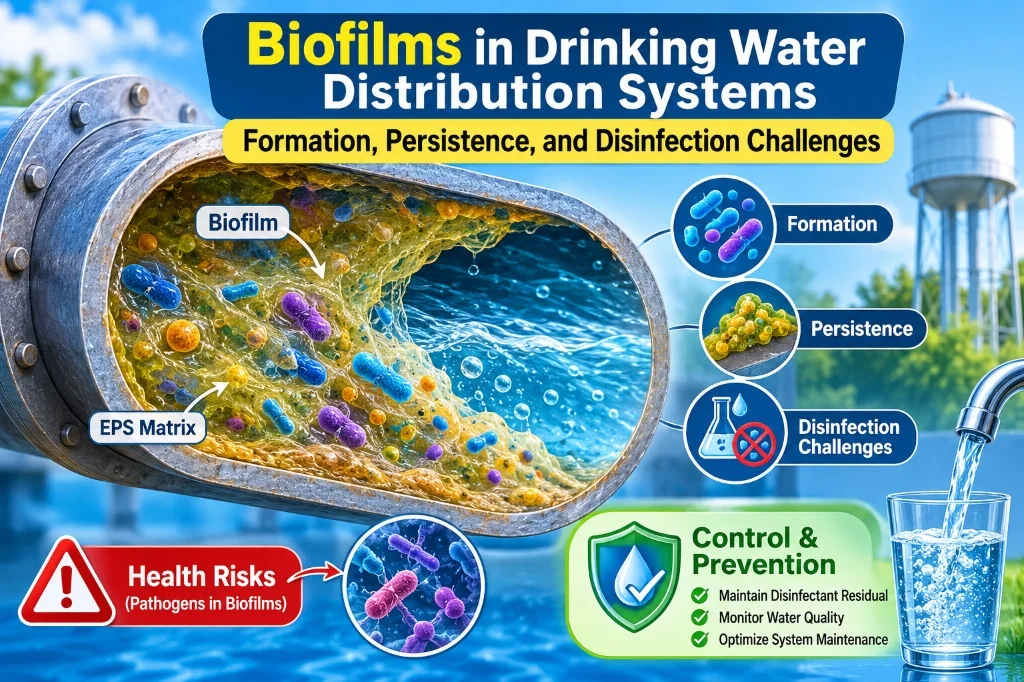
Figure 1: Overview of biofilm architecture, extracellular polymeric substance (EPS) matrix, opportunistic pathogen harboring, and disinfection challenges within drinking water distribution networks.
1. How Do Biofilms Form in Drinking Water Systems?
Biofilm development in drinking water infrastructure is not an instantaneous event; it is a progressive, multi-stage ecological succession occurring at the solid-liquid interface between the pipe wall and flowing water.
The 5 Stages of Biofilm Development:
┌─────────────────┐     ┌──────────────────┐     ┌──────────────────┐     ┌─────────────────┐     ┌──────────────────┐
│ 1. Conditioning │ ──> │ 2. Irreversible  │ ──> │ 3. Microcolony   │ ──> │ 4. Biofilm      │ ──> │ 5. Detachment &  │
│    & Reversible │     │    Attachment    │     │    Formation     │     │    Maturation   │     │    Dispersion    │
│    Attachment   │     │    (EPS Starts)  │     │    & Signaling   │     │    (Fluid Chan.)│     │    (Downstream)  │
└─────────────────┘     └──────────────────┘     └──────────────────┘     └─────────────────┘     └──────────────────┘
Stage 1: Surface Conditioning and Reversible Attachment
Immediately upon contact with water, the bare inner surface of a pipe adsorbs trace organic molecules (humic substances, proteins, and polysaccharides) to form a nanometer-scale “conditioning film.” Free-floating planktonic bacteria carried by water currents contact this surface via Brownian motion, sedimentation, or active motility. Initial binding is governed by weak, reversible physicochemical interactions, including van der Waals forces and electrostatic attractions.
Stage 2: Irreversible Attachment and EPS Secretion
Transiently bound bacteria activate specific surface-sensing signal cascades, deploying cellular appendages such as pili and flagella to stabilize contact. The pioneer cells then synthesize and excrete extracellular polymeric substances—composed primarily of polysaccharides, structural proteins, extracellular DNA (eDNA), and lipids. This sticky matrix anchors the cells irreversibly to the pipe substratum.
Stage 3: Microcolony Formation
Once anchored, microorganisms replicate locally. As density increases, cells communicate via chemical signaling molecules in a density-dependent process known as quorum sensing. This coordinating communication regulates metabolic adaptation, enhances EPS secretion, and recruits secondary colonizers from the bulk water phase.
Stage 4: Maturation and Complex Architecture
The mature biofilm develops a three-dimensional architecture featuring mushroom-like clusters interspersed with primitive water channels. These microscopic fluid conduits circulate bulk water through the biofilm interior, facilitating nutrient diffusion, oxygen delivery, and metabolic waste removal.
Stage 5: Detachment and Downstream Dispersion
Under hydrodynamic shear stress or internal enzymatic EPS degradation (such as during starvation), surface cells or entire clumps of biofilm shear off into the bulk water flow. These dispersed fragments seed downstream plumbing systems, colonize storage tanks, and occasionally emerge from consumer taps as sudden aesthetic or microbial compliance failures.
2. Dominant Bacterial Taxa in Drinking Water Distribution Networks
Drinking water biofilms host diverse microbial consortia adapted to extreme oligotrophic (low-nutrient) conditions:
| Bacterial Group / Genus | Ecological Niche & Characteristics in Distribution Systems |
|---|---|
| Pseudomonas spp. | Robust pioneer colonizers; prolific producers of alginate-rich EPS; highly adaptive to varying shear stress. |
| Sphingomonas spp. | Capable of utilizing complex, recalcitrant organic carbon compounds; key structural architects of oligotrophic biofilms. |
| Mycobacterium spp. (Non-tuberculous) | Characterized by thick, lipid-rich mycolic acid cell walls; naturally resistant to chlorine and quaternary ammonium disinfectants. |
| Legionella spp. | Intracellular parasites of free-living amoebae; proliferate in warm, stagnant premise plumbing and water heater loops. |
| Nitrospira & Nitrosomonas | Nitrifying bacteria common in chloraminated distribution networks; accelerate chloramine decay and promote nitrite accumulation. |
3. Factors Driving Biofilm Development in Distribution Networks
Biofilm proliferation is governed by complex interactions between water chemistry, hydraulic conditions, and pipeline materials:
Key Determinants of Biofilm Growth:
├── Nutrient Availability (Assimilable Organic Carbon - AOC)
├── Pipe Material & Corrosion Scale (Cast Iron vs. Ductile Iron vs. HDPE/PVC)
├── Water Temperature (Accelerated growth above 15°C–20°C)
├── Flow Hydraulics (Dead-ends, stagnation, and low-flow zones)
└── Disinfectant Residual Decay (Free Chlorine vs. Monochloramine)
1. Nutrient Availability: Assimilable Organic Carbon (AOC)
Even in drinking water that meets the strictest purity standards, trace amounts of biodegradable organic matter persist. Assimilable Organic Carbon (AOC) concentrations as low as 10 to 50 μg/L are sufficient to support extensive heterotrophic bacterial proliferation and continuous biofilm renewal.
2. Pipe Material and Surface Roughness
The composition and age of pipe infrastructure profoundly influence colonization:
- Unlined Cast Iron and Steel: Readily undergo electrochemical corrosion, forming tuberculation scales. These porous iron oxide crusts increase surface area exponentially, shield microorganisms from disinfectants, and neutralize chemical oxidants via iron-chlorine redox reactions.
- Polymeric Materials (HDPE, PVC, PEX): Smooth plastic surfaces resist tuberculation but can leach trace plasticizers, stabilizers, and volatile organic compounds that serve as direct microbial carbon sources.
- Cement-Mortar Linings: Provide a high-pH barrier initially, but leaching over time can alter local water chemistry and foster specialized alkaliphilic biofilms.
3. Temperature and Hydraulic Stagnation
Microbial metabolic kinetics accelerate significantly as seasonal water temperatures exceed 15°C to 20°C. Furthermore, low-velocity zones, dead-end mains, and oversized storage reservoirs create extended water residence times (water age), depleting residual disinfectant and allowing biofilms to thicken unhindered.
4. Why Are Biofilms So Difficult to Eliminate? Disinfectant Resistance vs. Tolerance
Water engineers often find that boosting chlorine dosing at the treatment plant fails to eradicate established pipe biofilms. Understanding why requires distinguishing between genetic resistance and phenotypic tolerance:
Mechanisms of Biofilm Disinfection Tolerance:
┌────────────────────────────────────────────────────────────────────────┐
│ 1. Diffusion Barrier & Oxidant Consumption                             │
│ • EPS biopolymer matrix physically retards chemical diffusion          │
│ • Surface EPS and iron deposits chemically neutralize chlorine         │
├────────────────────────────────────────────────────────────────────────┤
│ 2. Metabolic Heterogeneity & Persister Cells                           │
│ • Deep inner layers enter nutrient/oxygen-depleted dormant states       │
│ • Inactive cellular targets render antimicrobials ineffective          │
├────────────────────────────────────────────────────────────────────────┤
│ 3. Stress Response & Induction of VBNC State                           │
│ • Cells enter Viable-But-Nonculturable (VBNC) status                   │
│ • Cells retain pathogenic potential while evading standard plate counts│
└────────────────────────────────────────────────────────────────────────┘- Diffusion Limitation and Oxidant Quenching: Free chlorine is a strong, highly reactive oxidant. However, because it reacts aggressively with outer organic polymers and pipe scale, its concentration declines exponentially as it penetrates into the biofilm. Microorganisms nestled in the deeper basal layers encounter sub-lethal disinfectant concentrations.
- Phenotypic Dormancy (Persister Cells): Chemical disinfectants target active cellular machinery—such as respiratory enzymes, nucleic acid synthesis, and membrane transport systems. Deep within the biofilm, limited oxygen and nutrient gradients force bacteria into slow-growing, dormant “persister” states that are phenotypically insusceptible to oxidative destruction.
- The Viable-But-Nonculturable (VBNC) State: Exposure to chlorination frequently shocks bacteria into a VBNC state, where cells maintain intact membranes and metabolic respiration but fail to divide on standard agar media. Traditional regulatory culture methods report zero colonies, yielding a dangerous false sense of security.
5. Public Health Risks: Opportunistic Pathogens in Drinking Water
While the vast majority of biofilm inhabitants are harmless saprophytic environmental bacteria, biofilms act as natural incubation chambers for opportunistic premise plumbing pathogens (OPPPs):
Legionella pneumophila
The causative agent of Legionnaires’ disease and Pontiac fever does not simply survive in pipe scale; it has evolved to parasitize free-living waterborne amoebae (Acanthamoeba, Hartmannella, Vermamoeba). Biofilms provide grazing grounds for these protozoa. Legionella replicates inside amoebic cysts, which shield the bacteria from chlorine levels up to 50 mg/L and temperatures up to 60°C. Transmission occurs when colonized biofilms release cells into aerosol-generating fixtures—such as hospital showers, cooling towers, and decorative fountains.
Non-Tuberculous Mycobacteria (NTM)
Environmental mycobacteria, including Mycobacterium avium and Mycobacterium intracellulare, thrive in distribution biofilms and hot water plumbing. Their hydrophobic, waxy cell walls allow them to adhere tenaciously to plastic piping and resist chlorine concentrations that readily eradicate coliforms. Inhaled or aspirated NTM cause refractory pulmonary infections, particularly in immunocompromised or elderly populations.
Pseudomonas aeruginosa
An opportunistic pathogen notorious for multi-drug resistance, P. aeruginosa readily colonizes hospital sinks, taps, and premise plumbing biofilms, posing severe risks for burn units, intensive care patients, and catheterized individuals.
6. Disinfection Challenges: Comparing Secondary Disinfectants
Maintaining an active disinfectant residual to the furthest tap in a distribution network requires balancing biocidal efficacy against disinfectant decay and disinfection by-product (DBP) formation:
| Disinfectant | Biocidal Potency (Planktonic) | Biofilm Penetration | Residual Longevity | Primary Limitation |
|---|---|---|---|---|
| Free Chlorine (HOCl / OCl−) | High | Poor to Moderate | Moderate | Rapidly consumed by pipe scale and organic matter; forms regulated DBPs (trihalomethanes, haloacetic acids). |
| Monochloramine (NH2Cl) | Moderate | High | Long | Slower oxidant that penetrates deeply into EPS; however, can trigger nitrification and is less effective against viruses and protozoa. |
| Chlorine Dioxide (ClO2) | High | Moderate to High | Moderate | Excellent against Legionella and biofilms; does not form THMs, but requires on-site generation and forms chlorite/chlorate residuals. |
| Ozone (O3) | Exceptional | Not Applicable | Zero (Minutes) | Extremely potent primary disinfectant at the treatment plant, but leaves zero secondary residual in distribution pipelines. |
7. Integrated Strategies for Biofilm Control and Prevention
Eradicating biofilms from thousands of kilometers of buried infrastructure is biologically impossible. Modern water utility management focuses on integrated barrier strategies to suppress biomass accumulation and maintain microbiological stability:
Multi-Barrier Biofilm Management:
├── 1. Upstream Treatment: Biofiltration & GAC to minimize AOC (<50 µg/L)
├── 2. Disinfectant Residual: Maintain >0.2 mg/L free chlorine or >0.5 mg/L chloramine
├── 3. Unidirectional Flushing: High-velocity scour (>1.5 m/s) to strip loose sediments
├── 4. Asset Rehabilitation: Trenchless epoxy lining or replacement of corroded mains
└── 5. Continuous Monitoring: Rapid ATP, flow cytometry, and qPCR monitoring- Nutrient Starvation via Advanced Water Treatment: Utilizing biological active carbon (BAC) and nanofiltration during primary treatment strips assimilable organic carbon (AOC) down to levels (<50 μg/L) that starve distribution biofilms of growth substrates.
- Hydraulic Management & Unidirectional Flushing (UDF): Routine, systematic unidirectional flushing creates controlled, high-velocity shear stress (>1.5 m/s) that scours accumulated biofilm biomass and loose loose corrosion deposits out of hydrants, eliminating stagnant dead-ends.
- Targeted Disinfectant Residual Management: Optimizing residual concentrations throughout long distribution loops—including automated booster chlorination stations in outlying reservoirs—prevents localized disinfectant depletion.
- Premise Plumbing Thermal Shocking & Copper-Silver Ionization: In complex healthcare facilities and nursing homes, secondary on-site disinfection systems (such as continuous copper-silver ionization or periodic thermal flushing above 60°C) are implemented to suppress premise plumbing Legionella colonization.
8. Future Perspectives: Modern Molecular Tools in Water Microbiology
The historical practice of relying solely on heterotrophic plate counts (HPC) and coliform culture tests is giving way to high-resolution molecular diagnostics:
- Metagenomic Shotgun Sequencing: Deciphers the complete phylogenetic composition and functional metabolic pathways of intact biofilm communities without culture bias.
- Quantitative Real-Time PCR (qPCR) & Digital PCR (dPCR): Enables absolute quantification of unculturable opportunistic pathogens like Legionella pneumophila and Mycobacterium avium in water samples within 2 hours.
- Online Bioburden Monitoring & Flow Cytometry: Rapid fluorogenic cell counters quantify intact microbial cells (intact cell count, ICC) and distinguish them from membrane-damaged cells in real time, delivering proactive alerts to water treatment operators.
- Enzymatic EPS Degradation & Quorum Quenching: Cutting-edge research is exploring natural enzymes (alginate lyases, DNases) and quorum-sensing inhibitor molecules capable of dissolving the EPS matrix, making persister cells susceptible to standard municipal chlorine concentrations.
Conclusion
Biofilms in drinking water distribution systems are complex microbial ecosystems that challenge conventional water treatment paradigms. Their self-produced extracellular polymeric substance (EPS) matrix and phenotypic dormancy provide effective armor against routine chemical disinfection, transforming pipelines into long-term reservoirs for opportunistic pathogens.
Ensuring safe drinking water from the treatment plant to the consumer tap requires more than simply adding chlorine at the headworks. It demands a holistic, multi-barrier strategy: reducing assimilable organic nutrients during primary filtration, maintaining adequate disinfectant residuals across distribution extremities, managing pipe hydraulics, and adopting rapid molecular monitoring tools.
By understanding the microbial ecology governing biofilm development, water utilities and public health professionals can safeguard water quality and protect vulnerable communities from waterborne illness.