- 1 1. Core Viral Vector Platforms in Modern Gene Therapy
- 2 2. End-to-End Viral Vector Biomanufacturing Workflow
- 3 3. Challenge 1: Maintaining High Viral Vector Yield
- 4 4. Challenge 2: Achieving High Vector Purity
- 5 5. Challenge 3: Ensuring Uncompromising Vector Safety
- 6 6. Analytical Testing Matrix: Comprehensive Quality Control
- 7 7. The Role of cGMP in Clinical Gene Therapy Facilities
- 8 8. Future Innovations Transforming Viral Vector Manufacturing
- 9 Conclusion
Gene therapy has crossed the threshold from an experimental scientific ambition to a clinically validated treatment paradigm for severe inherited monogenic disorders, hematologic malignancies, and refractory neuromuscular diseases.
Therapies based on modified viral vectors have achieved preeminence because viruses have evolved over billions of years to specialize in one core function: the highly efficient transfer of genetic material into host cells. By genetically gutting these viral systems—removing pathogenic and replication machinery while preserving the structural capsid and cis-acting delivery signals—biomedical scientists convert natural infectious agents into precision molecular delivery vehicles.
However, translating a laboratory proof-of-concept into an approved, commercialized clinical therapy presents an engineering challenge of immense proportions. Clinical-grade viral vector biomanufacturing is among the most intricate, variable, and expensive bioprocesses in modern biotechnology. Every therapeutic lot must satisfy unforgiving regulatory standards for identity, potency, purity, safety, and batch-to-batch consistency.
This introduces the central dilemma confronting gene therapy developers: how can biomanufacturers scale up production to deliver trillions of functional vector genomes without compromising product safety or therapeutic purity?
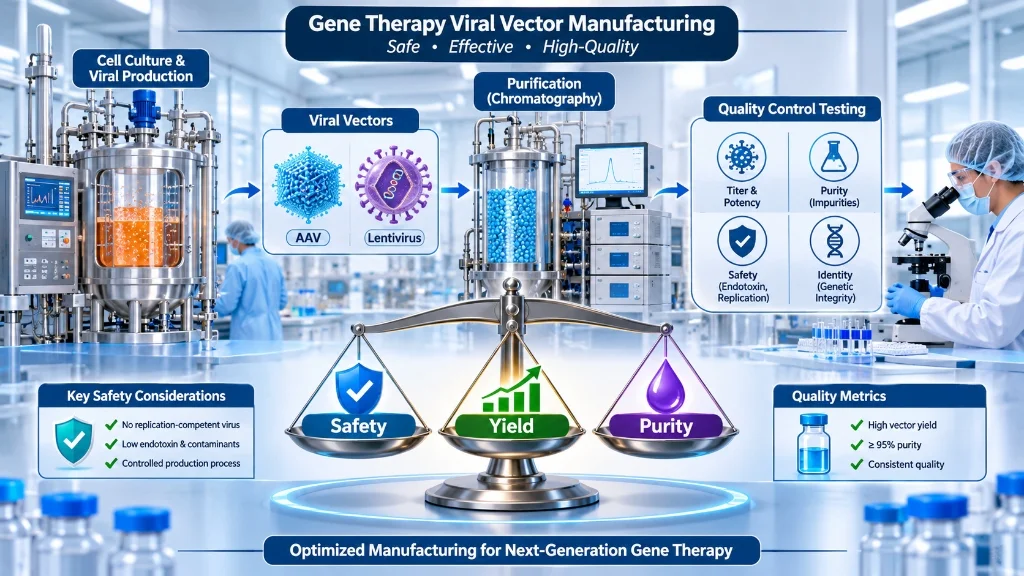
Figure 1: Upstream bioprocessing, downstream purification chromatography, and analytical quality control testing in gene therapy viral vector manufacturing.
1. Core Viral Vector Platforms in Modern Gene Therapy
While several viral families have been engineered for gene transfer, three platforms dominate clinical pipelines, each presenting unique biophysical architectures and manufacturing hurdles:
Principal Clinical Vector Platforms:
├── Adeno-Associated Virus (AAV): In Vivo Gene Delivery (Non-integrating, Low Immunogenicity)
├── Lentivirus (LV): Ex Vivo Cell Engineering (Integrating, Long-Term CAR-T & HSC Transduction)
└── Adenovirus (AdV): Vaccines & Oncolytic Immunotherapies (High Payload, Transient Expression)
Adeno-Associated Virus (AAV)
- Biological Characteristics: Small (~25 nm), non-enveloped, single-stranded DNA dependovirus of the Parvoviridae family.
- Clinical Niche: The vehicle of choice for in vivo systemic and localized gene replacement (targeting liver, central nervous system, retina, and skeletal muscle).
- Packaging Bottleneck: Strict genome packaging capacity of approximately 4.7 kilobases (kb). Over-sized genomes lead to truncated, non-functional capsids.
- Manufacturing Distinction: Produces an excess of “empty” capsids (capsids containing no vector genome) that co-purify with functional particles.
Lentiviral Vectors (LV)
- Biological Characteristics: Enveloped, spherical (~80–120 nm), pseudo-diploid RNA retroviruses (typically derived from HIV-1).
- Clinical Niche: The standard platform for ex vivo cell therapy, including chimeric antigen receptor (CAR) T-cell manufacturing and autologous hematopoietic stem cell (HSC) gene modification.
- Key Advantage: Stable genomic integration into dividing and non-dividing cells, ensuring lifelong expression across proliferating daughter cells.
- Manufacturing Vulnerability: Enveloped particles are fragile and shear-sensitive; low stability during downstream ultracentrifugation or membrane filtration.
Adenoviral Vectors (AdV)
- Biological Characteristics: Medium-sized (~90–100 nm), non-enveloped, double-stranded DNA viruses with an icosahedral capsid.
- Clinical Niche: Genetic vaccines (such as viral-vectored COVID-19 and Ebola vaccines) and oncolytic cancer immunotherapy.
- Key Advantage: Large packaging capacity (>8 kb up to 36 kb in helper-dependent “gutless” vectors) and very high titers.
- Limitation: High native immunogenicity stimulates intense host innate and neutralizing antibody responses, restricting repetitive administration.
2. End-to-End Viral Vector Biomanufacturing Workflow
Regardless of the specific viral chassis, clinical-grade vector manufacturing proceeds through a standardized series of unit operations governed by current Good Manufacturing Practice (cGMP).
End-to-End Viral Vector Manufacturing Workflow:
┌───────────────────────────┐     ┌───────────────────────────┐     ┌───────────────────────────┐
│ Upstream Bioprocessing    │ ──> │ Downstream Processing     │ ──> │ Fill-Finish & QC Testing  │
│ • Host cell expansion     │     │ • Clarification & Lysis   │     │ • Sterile filtration      │
│ • Multi-plasmid transfect.│     │ • Nuclease (Benzonase)    │     │ • Release assays (ddPCR)  │
│ • Bioreactor expression   │     │ • TFF & Chromatography    │     │ • Cryopreservation (-80°C)│
└───────────────────────────┘     └───────────────────────────┘     └───────────────────────────┘
Upstream Biomanufacturing
- Cell Line Expansion: Host production cells (predominantly human embryonic kidney HEK293 or HEK293T variants, or insect Sf9 cells for baculovirus systems) are expanded from cryopreserved master cell banks into high-density suspension bioreactors (stirred-tank, wave-mixed, or fixed-bed systems).
- Genetic Delivery: In transient transfection protocols, production cells are co-transfected with multiple purified plasmid constructs:
- For AAV (Triple Transfection): (1) Transfer plasmid containing therapeutic transgene flanked by inverted terminal repeats (ITRs); (2) Rep/Cap plasmid supplying replication and serotype-specific structural proteins; (3) Helper plasmid providing adenoviral E2A, E4orf6, and VA RNA helper functions.
- For Lentivirus (4-Plasmid Split System): (1) Transgene transfer vector with modified LTRs; (2) Packaging plasmid (gag/pol); (3) Rev expression plasmid; (4) Envelope plasmid (typically expressing Vesicular Stomatitis Virus G glycoprotein, VSV-G).
- Viral Particle Assembly & Harvest: Vector assembly occurs over 48–72 hours post-transfection. For lentiviruses and certain AAV serotypes (AAV8, AAV9), vectors are shed into the culture supernatant. For cell-retained serotypes (AAV2), chemical or mechanical cell lysis is required.
Downstream Purification
- Clarification: Depth filtration and microfiltration remove cellular debris and unlysed host cells without clogging downstream membrane surfaces.
- Nuclease Digestion: High-purity endonucleases (such as Benzonase or Denarase) are added to hydrolyze viscous host-cell genomic DNA (hcDNA) and residual plasmid fragments into small oligonucleotides.
- Tangential Flow Filtration (TFF): Ultrafiltration/diafiltration membranes concentrate vector volume and perform buffer exchange, clearing small fragmented proteins and salts.
- Chromatography: Multiple orthogonal chromatographic steps separate vectors from contaminants:
- Affinity Chromatography: Uses serotype-specific ligands or synthetic camelid antibody fragments to capture intact capsids with high selectivity.
- Anion-Exchange (AEX) Chromatography: Exploits subtle differences in surface isoelectric charge between empty capsids and negatively charged DNA-filled capsids to enrich full particles.
- Sterile Filtration & Final Formulation: 0.22 μm bioburden-reduction filtration followed by addition of cryoprotectants (e.g., Pluronic F-68, trehalose) to prevent particle aggregation during storage at −80°C.
3. Challenge 1: Maintaining High Viral Vector Yield
Clinical gene therapy requires staggering quantities of viral particles. An in vivo systemic intravenous administration for Duchenne muscular dystrophy or spinal muscular atrophy can demand doses of 1 × 10¹⁴ to 1 × 10¹⁵ vector genomes (vg) per patient. Manufacturing single batches capable of treating dozens of patients requires yields in the range of 1016 to 1017 vg.
Primary Upstream Yield Bottlenecks:
├── Transfection Inefficiency at Large Bioreactor Volumes (>500 L)
├── Plasmid DNA Stoichiometry & Polyethylenimine (PEI) Complexation
├── Metabolic By-Product Accumulation (Lactate, Ammonia, Osmolality Shifts)
└── "Physical" vs. "Functional" Vector Mismatch (Empty vs. Full Particles)
Physical Yield vs. Functional Potency
A common pitfall in vector processing is conflating total physical capsid output with therapeutic vector potency:
- An AAV lot may display a high physical titer (1 × 10¹³ capsids/mL), yet 70% to 90% of those capsids may be empty or contain truncated, non-functional DNA fragments.
- Lentiviral particles may incorporate defective reverse transcriptase or miss envelope glycoproteins, yielding high p24 protein concentrations with near-zero biological transduction activity (low TU/mL).
Scaling Transient Transfection
Transient transfection using chemical carriers like polyethylenimine (PEI) works predictably in 2-liter benchtop vessels. However, scaling to 500-liter or 2,000-liter stirred-tank bioreactors is hindered by rapid complexation kinetics: DNA-PEI nanoparticles precipitate within minutes, making uniform distribution across huge volumes technically daunting.
4. Challenge 2: Achieving High Vector Purity
Downstream processing must systematically purge thousands of host-derived and process-derived contaminants while minimizing shear damage to fragile capsids.
| Impurity Class | Source in Bioprocess | Safety & Efficacy Concern | Primary Downstream Removal Unit |
|---|---|---|---|
| Host-Cell Proteins (HCPs) | Lysed HEK293 production cells | Severe immunogenicity, patient anaphylaxis, and product instability | Affinity capture, wash steps, ion-exchange chromatography |
| Host-Cell DNA (hcDNA) | Host cellular genome fragmentation | Risk of insertional oncogenesis and viral transmission; FDA limits hcDNA to <10 ng/dose | High-efficiency endonuclease digestion (Benzonase) & TFF |
| Residual Plasmid DNA | Transfection raw materials | Transfer of antibiotic resistance genes or non-target regulatory elements | Anion-exchange chromatography, enzymatic degradation |
| Empty / Partial Capsids | Defective packaging during viral assembly | Compete for cellular receptors; increase immunogenicity without clinical benefit | Strong anion-exchange (AEX) chromatography, CsCl/iodixanol ultracentrifugation |
| Endotoxin (LPS) | Trace bacterial raw materials or equipment | Pyrogenic response, septic shock, and cytokine release | Ultrafiltration, polymyxin B affinity polishing |
The Empty vs. Full Capsid Dilemma in AAV
Empty capsids present identical outer protein coat structures to full capsids. Delivering millions of empty capsids into a patient unnecessarily floods the immune system with foreign viral antigens, priming neutralizing antibodies and cytotoxic T-cell responses against transduced target tissues without conferring any therapeutic benefit. Separating them demands ultra-fine resin resolution via quaternary amine strong anion-exchange columns with precise salt or pH step gradients.
5. Challenge 3: Ensuring Uncompromising Vector Safety
Safety in gene therapy biomanufacturing is non-negotiable. Because these therapeutics are administered parenterally and frequently exert permanent genetic alterations, safety risks must be eliminated at the molecular level:
Critical Safety Assurance Priorities:
├── Replication-Competent Virus (RCV) Absence Testing (rcAAV / RCL)
├── Residual Host-Cell DNA Size Limitation (<200 bp)
├── Adventitious Agent Testing (Mycoplasma, Retroviruses, Sterility)
└── Endotoxin Control for Parenteral Administration (<5 EU/kg/hr)
Replication-Competent Lentivirus (RCL)
When generating lentiviral vectors from pathogenic retroviruses, the foremost regulatory concern is the inadvertent generation of replication-competent lentivirus through homologous recombination. Modern manufacturing utilizes third-generation, four-plasmid split systems where regulatory elements (tat and rev) are split onto separate constructs, and the U3 region of the 3′ LTR is deleted to create self-inactivating (SIN) vectors. Before release, large-volume culture-based indicator assays (e.g., C8166 T-cell propagation for 21 days) must verify complete RCL absence.
Residual DNA Oncogenicity
Host-cell genomic DNA carryover poses theoretical risks of insertional mutagenesis or oncogene transfer if high-molecular-weight fragments persist. Health authorities strictly mandate that residual hcDNA be limited to less than 10 nanograms per therapeutic dose, with the majority of fragments digested to under 200 base pairs in length.
6. Analytical Testing Matrix: Comprehensive Quality Control
Releasing a clinical-grade viral vector batch requires an extensive battery of qualified, phase-appropriate orthogonal analytical assays:
| Quality Attribute | Analytical Technique | Regulatory & Pharmacopoeial Target |
|---|---|---|
| Vector Genome Titer (vg/mL) | Droplet Digital PCR (ddPCR) or qPCR | Measures absolute concentration of intact therapeutic transgenes |
| Physical Particle Titer | ELISA (capsid-specific), HPLC, or Nanoparticle Tracking Analysis (NTA) | Determines total capsid concentration |
| Full / Empty Capsid Ratio | Analytical Ultracentrifugation (AUC), Cryo-TEM, or Charge-Detection MS | Quantifies percentage of full (>70–80%), empty, and partially filled capsids |
| Biological Potency (TU/mL) | Cell-based transduction assay & flow cytometry / reporter gene readout | Establishes biological activity in living target cells |
| Purity & Capsid Identity | SDS-PAGE, Capillary Electrophoresis (CE-SDS), and Reversed-Phase HPLC | Verifies VP1, VP2, VP3 stoichiometry (~1:1:10) and absence of HCPs |
| Residual Host-Cell DNA | Quantitative PCR (targeting human Alu repeats or 18S rDNA) | Confirms <10 ng/dose; size distribution <200 bp via bioanalyzer |
| Sterility | Compendial 14-day sterility test (USP <71>) or validated RMM | Absence of viable bacterial and fungal contamination |
| Bacterial Endotoxin | Limulus Amebocyte Lysate (LAL) or Recombinant Factor C (rFC) assay | Strictly below pharmacopoeial limits based on patient body weight |
7. The Role of cGMP in Clinical Gene Therapy Facilities
Manufacturing viral vectors for human clinical trials or commercial distribution must adhere strictly to current Good Manufacturing Practice:
- Closed Processing Systems: Transitioning from open biosafety cabinet manipulations to fully closed, automated single-use fluid pathways prevents operator-induced microbial contamination.
- Segregated Multi-Product Facilities: Because viral vectors are infectious biological particles, facilities require unidirectional personnel flow, differential air pressure cascades (negative pressure suites for BSL-2 vector production), and validated terminal vaporization hydrogen peroxide (VHP) decontamination to avoid cross-contamination between different viral constructs.
- Process Analytical Technology (PAT): Incorporating real-time sensors (in-line Raman spectroscopy, capacitance biomass probes, and automated off-gas analyzers) into bioreactor control loops enables dynamic feedback and stabilizes batch-to-batch yield.
8. Future Innovations Transforming Viral Vector Manufacturing
To meet global clinical demand and reduce the prohibitive cost of gene therapies (often exceeding USD 1 million per dose), bioprocess engineers are driving major technological shifts:
- Stable Packaging & Producer Cell Lines: Replacing multi-plasmid transient transfection with stable mammalian producer cell lines where all packaging genes are stably integrated into the host genome. Induction of vector production with small molecules (e.g., cumate or tetracycline) eliminates expensive plasmid raw materials and simplifies scale-up.
- Continuous Bioprocessing & Perfusion Bioreactors: Operating bioreactors in continuous perfusion mode with alternating tangential flow (ATF) filtration removes viral particles continuously as they are shed, minimizing thermal degradation and increasing volumetric productivity by 5-fold to 10-fold compared to batch operations.
- Advanced Synthetic Capsid Engineering: Employing artificial intelligence and directed evolution to engineer synthetic viral capsids exhibiting hyper-targeted tissue tropism, higher packaging stability, and reduced pre-existing human neutralizing antibody recognition.
Conclusion
Viral vector manufacturing represents the physical foundation upon which the entire gene therapy revolution rests. While designing an elegant therapeutic genetic construct is a breakthrough in molecular biology, successfully producing, purifying, and releasing clinical-grade viral vectors at industrial scale is the ultimate test of bioprocess engineering.
Biomanufacturers must continually calibrate the delicate equilibrium between three interdependent forces: maximizing physical and functional yield, eliminating hazardous process- and host-derived impurities, and enforcing absolute biological safety.
As single-use bioreactor platforms mature, stable producer lines replace manual transfection, and high-resolution analytics like digital droplet PCR and analytical ultracentrifugation become standard, viral vector production will become more scalable, reproducible, and cost-effective—ensuring that life-saving genetic medicines reach the patients who need them most.