- 1 1. What Are Rapid Microbiological Methods (RMMs)?
- 2 2. Why Are Pharmaceutical Manufacturers Transitioning Toward RMMs?
- 3 3. The Four Core Analytical Categories of RMMs
- 4 4. Traditional Plate Counts vs. Rapid Microbiological Methods
- 5 5. Critical Applications Across Pharmaceutical Facilities
- 6 6. Global Regulatory Frameworks: Can Traditional Methods Be Replaced?
- 7 7. Key Validation Parameters for RMM Implementation
- 8 8. Current Implementation Hurdles & Industry Barriers
- 9 9. Are Traditional Plate Counts Becoming Obsolete? The Hybrid Future
- 10 Conclusion
In pharmaceutical manufacturing, detecting microbial contamination is never simply an academic laboratory exercise. It is a vital pillar of product quality, patient safety, and regulatory compliance.
For over a century, pharmaceutical microbiology laboratories have relied almost exclusively on traditional culture-based techniques—most notably agar plate counts and liquid broth enrichment—to evaluate bioburden in raw materials, water systems, cleanroom environments, and finished drug products. While these compendial methods remain foundational standards, they carry one fundamental drawback: they take days or weeks to produce results.
Waiting several days for microbial colonies to emerge on solid agar can stall quality control (QC) decisions, halt manufacturing campaigns, and postpone final batch release. In contemporary manufacturing—particularly for time-critical cell therapies, radiopharmaceuticals, and biologics with ultra-short shelf lives—these retrospective delays represent a critical operational bottleneck.
This is where Rapid Microbiological Methods (RMMs) are reshaping pharmaceutical quality control. By leveraging technologies such as ATP bioluminescence, solid-phase cytometry, automated colony imaging, flow cytometry, and quantitative molecular assays, facilities can obtain microbial data within hours, or even in real time.
Does this mean traditional plate counts are headed for extinction? Not quite. The reality of modern pharmaceutical quality assurance points toward a coordinated hybrid model, where validated rapid technologies and traditional culture methods complement one another based on risk and intended analytical application.
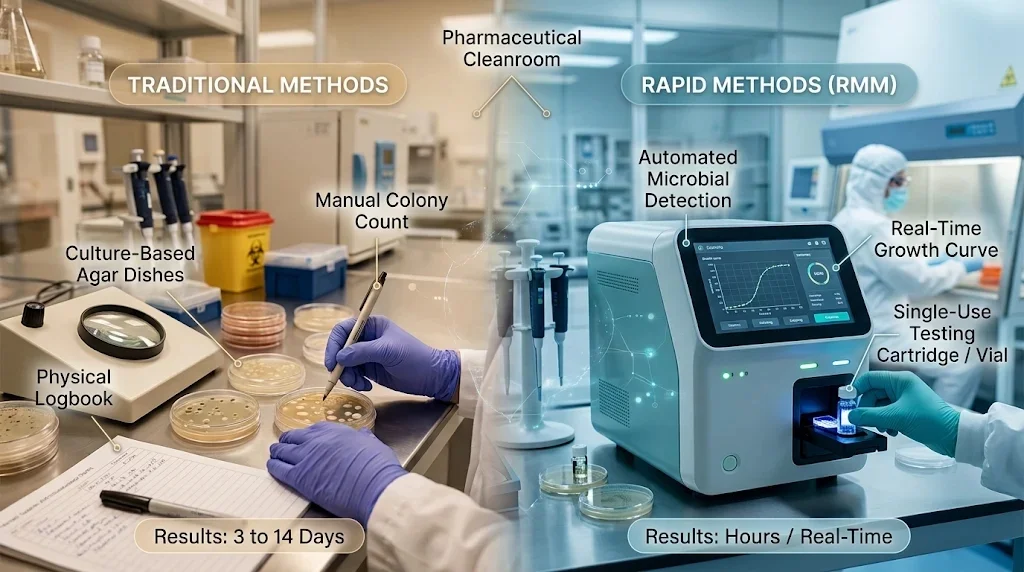
Figure 1: Traditional culture-based plate counting (3 to 14 days) versus modern Rapid Microbiological Methods (hours to real-time) in pharmaceutical quality control.
1. What Are Rapid Microbiological Methods (RMMs)?
Rapid Microbiological Methods are modern analytical technologies designed to detect, enumerate, or identify microorganisms significantly faster than compendial culture-based procedures.
Where traditional testing relies on the replication of viable cells into macroscopic colonies (colony-forming units, or CFU) or visible turbidity over 48 hours to 14 days, RMMs capture distinct biological, biochemical, optical, or biophysical signals directly from the sample:
- Viable Organisms: Measuring cellular proliferation at microscopic levels long before colonies are visible to the naked eye.
- Metabolic Activity: Tracking enzymatic reactions, gas evolution, or energy turnover (e.g., ATP turnover).
- Structural Biomarkers: Detecting specific cell-wall components, membrane potentials, or lipid profiles.
- Genomic Signatures: Amplifying specific microbial nucleic acids (DNA or RNA) via PCR or sequencing.
- Individual Particle Properties: Interrogating single cells via laser-induced fluorescence or microfluidic impedance.
Crucial Analytical Distinction: Not every rapid method measures the same biological phenomenon. A viability-based fluorogenic assay interrogates membrane integrity; an ATP bioluminescence assay measures active cellular energy; and a PCR assay detects target genetic sequences that may persist even after cell death. Therefore, a rapid result cannot simply be treated as an exact 1:1 analogue to a conventional CFU count without careful context and validation.
2. Why Are Pharmaceutical Manufacturers Transitioning Toward RMMs?
Traditional microbiological testing has served the industry well, but modern biopharmaceutical manufacturing and continuous processing require faster, more dynamic feedback loops.
Drivers Accelerating RMM Adoption:
├── Retrospective vs. Proactive Control (Hours instead of 14 Days)
├── Process Analytical Technology (PAT) & Real-Time Release Testing (RTRT)
├── Time-Critical Therapeutics (CAR-T, Autologous Cell Therapies, Radioligands)
└── Continuous Water & Environmental Quality Monitoring
Long Turnaround Times of Compendial Methods
Under traditional compendial standards:
- Microbial Enumeration Tests (USP <61> / Ph. Eur. 2.6.12): Require 3 to 7 days of incubation.
- Compendial Sterility Testing (USP <71> / Ph. Eur. 2.6.1): Mandates a 14-day incubation period across two distinct media (Fluid Thioglycollate Medium at 30–35°C and Soybean-Casein Digest Medium at 20–25°C).
- Mycoplasma Cultivation (USP <63> / Ph. Eur. 2.6.7): Can require 28 days of incubation.
Throughout these incubation intervals, millions of dollars in finished pharmaceutical inventory must sit in quarantine warehouses, accumulating holding costs and delaying patient access.
Proactive Contamination Control & Faster Decisions
Consider a pharmaceutical facility monitoring a Purified Water (PW) or Water for Injection (WFI) loop. If an alert-level excursion is detected via an agar plate 5 days after sampling, that contaminated water may have already been used to formulate multiple commercial batches or clean downstream bioreactors. RMMs shift microbiology from a retrospective forensic tool to an in-process proactive safeguard.
Products with Ultra-Short Shelf Lives
The growth of Advanced Therapy Medicinal Products (ATMPs), such as autologous CAR-T cell therapies and personalized cancer vaccines, presents a unique challenge: these patient-specific products frequently have a shelf life measured in hours or a few days. They cannot wait 14 days for a compendial sterility release. Rapid sterility and bioburden methods provide the only feasible analytical route to confirm safety prior to patient infusion.
3. The Four Core Analytical Categories of RMMs
Industry guidance documents—including the Parenteral Drug Association (PDA) Technical Report No. 33 and pharmacopoeial chapters—classify RMMs into four primary functional categories based on their detection principles.
Rapid Microbial Methods (RMM)
├── 1. Growth-Based Systems (Microcolony imaging, auto-fluorescence, CO2 monitoring)
├── 2. Viability-Based Systems (Flow cytometry, solid-phase laser cytometry, vital dyes)
├── 3. Metabolite-Based Systems (ATP bioluminescence, colorimetric gas changes)
└── 4. Nucleic Acid-Based Systems (qPCR, RT-PCR, dPCR, NGS)
Category 1: Growth-Based Rapid Methods
Growth-based RMMs still require cell division, but they utilize high-sensitivity optoelectronic sensors to detect microcolonies days before they become visible to human inspectors.
- Technological Mechanisms: Automated digital imaging, autofluorescence scanning, and laser-assisted surface scanning.
- Working Principle: Samples are filtered across a membrane, placed on growth medium, and incubated. Specialized optics detect microcolonies containing as few as 20–100 cells.
- Key Advantage: Retains traditional culture principles while reducing incubation times by 50% to 75% (e.g., results in 18–36 hours instead of 5–7 days).
- Limitations: Slow-growing fastidious environmental isolates or viable-but-nonculturable (VBNC) organisms can still pose kinetic bottlenecks.
Category 2: Viability-Based Methods (Fluorescence & Cytometry)
Viability-based platforms detect individual living microorganisms without requiring extended incubation periods.
- Technological Mechanisms: Solid-Phase Cytometry (SPC) and High-Throughput Flow Cytometry.
- Working Principle: Cells are labeled with fluorogenic viability substrates (e.g., fluorescein diacetate derivatives). Intracellular esterases in metabolically active cells cleave non-fluorescent substrates into fluorescent compounds that remain trapped within intact cell membranes. Laser excitation detects these individual fluorescent events.
- Key Advantage: Enables single-cell enumeration in filterable samples within 2 to 4 hours, independent of microbial growth rate.
- Limitations: Product particulates, cellular debris, and auto-fluorescent excipients can create optical noise; requires extensive matrix-specific clearing protocols.
Category 3: Metabolite-Based Methods (ATP Bioluminescence)
Metabolite-based platforms measure universal biochemical intermediates produced by viable organisms.
- Technological Mechanisms: Adenosine Triphosphate (ATP) Bioluminescence.
- Working Principle: Microbial ATP reacts with recombinant luciferase and luciferin in the presence of magnesium ions, emitting photons measured by a luminometer:
ATP + Luciferin + O2 → [Luciferase, Mg2+] → Oxyluciferin + AMP + PPi + CO2 + Light (560 nm)
- Key Advantage: Fast readouts (often under 10–30 minutes), making it the gold standard for rapid surface hygiene verification and rapid filter-based screening.
- Limitations: Non-microbial somatic ATP (from human skin, mammalian cells, or plant extracts) must be eliminated using enzymatic apyrase pre-treatments, or false positives will occur.
Category 4: Nucleic Acid-Based Methods (PCR & Sequencing)
Molecular methods eliminate culture entirely by amplifying specific genomic target sequences.
- Technological Mechanisms: Real-Time Quantitative PCR (qPCR), Digital PCR (dPCR), and Next-Generation Sequencing (NGS).
- Working Principle: Microbial cells are lysed, DNA or RNA is purified, and sequence-specific primers amplify conserved ribosomal loci (e.g., 16S rRNA for bacteria, 18S/ITS for fungi).
- Key Advantage: High specificity, automated identification down to the species level, and the ability to detect unculturable organisms within hours.
- Limitations: Free DNA from non-viable organisms (killed during thermal or chemical processing) can lead to false-positive alarms unless pre-treated with photoreactive intercalating dyes like Propidium Monoazide (PMA).
4. Traditional Plate Counts vs. Rapid Microbiological Methods
| Analytical Parameter | Traditional Plate Counts (Compendial) | Rapid Microbiological Methods (RMM) |
|---|---|---|
| Detection Signal | Visual colony development on agar | Optical, fluorescent, metabolic, or molecular signals |
| Time to Result | 2 to 14 days | Minutes to 24–48 hours |
| Viability Measurement | Organisms capable of forming colonies under specific medium/temperature conditions | Varies: metabolic activity, membrane integrity, or genomic presence |
| Detection of VBNC Cells | Blind to viable-but-nonculturable states | Capable of detecting intact/viable VBNC populations |
| Species Identification | Requires secondary subculturing and phenotypic/MALDI-TOF workup | Often integrated (in molecular systems) or accelerated |
| Laboratory Footprint | Large incubators and manual colony counting benches | Compact benchtop instruments with automated data integration |
| Regulatory Validation | Standard compendial status (no primary validation needed for standard matrices) | Requires formal validation under USP <1223> and Ph. Eur. 5.1.6 |
| Primary Risk Factor | Slow reporting delays contamination containment | Signal interpretation, matrix interference, and non-viable detection |
5. Critical Applications Across Pharmaceutical Facilities
Pharmaceutical RMM Deployment Areas:
├── Water Systems: Online fluorescence bioburden monitoring in WFI & Purified Water
├── Environmental Monitoring: Continuous air sampling & rapid contact plate screening
├── In-Process Bioburden: Rapid release prior to sterile filtration or terminal sterilization
├── Sterility Testing: 5-to-7 day rapid automated systems for biologics & ATMPs
└── Cleaning Validation: Immediate ATP & fluorogenic verification of clean-in-place (CIP)
1. Pharmaceutical Water Monitoring
Water for Injection and Purified Water loops require stringent microbiological control (<10 CFU/100 mL for WFI). Using real-time laser-induced fluorescence water monitors, facilities can continuously observe bioburden spikes within distribution loops, catching biofilm shedding before contaminated water enters formulation tanks.
2. Environmental Monitoring (EM) in Cleanrooms
In aseptic processing zones (Grade A / ISO 5), settling plates and active air samples traditionally take up to a week to incubate. Automated biofluorescent air monitors can detect and differentiate biological cells from inert dust particles continuously, alerting operators to gowning failures or barrier breaches in real time.
3. Rapid Sterility Testing
Replacing the 14-day USP <71> test with validated RMMs (such as growth-based automated carbon-dioxide monitoring or membrane-based ATP bioluminescence) can reduce sterility turnaround to 5–7 days, and in some specialized cell therapy applications, down to 48 hours.
6. Global Regulatory Frameworks: Can Traditional Methods Be Replaced?
A common misconception is that regulatory agencies strictly mandate traditional agar plates. In truth, regulatory bodies actively encourage the implementation of validated alternative microbiological methods:
United States Pharmacopeia: USP <1223>
USP General Chapter <1223> (Validation of Alternative Microbiological Methods) establishes the fundamental principles for demonstrating that an alternative technology is suitable for its intended purpose and provides performance equivalence or superiority to the compendial method.
European Pharmacopoeia: Ph. Eur. 5.1.6
European Pharmacopoeia General Chapter 5.1.6 (Alternative Methods for Control of Microbiological Quality) is recognized globally as one of the most comprehensive regulatory frameworks for RMMs.
Important Regulatory Milestone: In March 2026, the European Pharmacopoeia Commission adopted a comprehensively modernized revision of Chapter 5.1.6 (published in Ph. Eur. Issue 13.2 in July 2026, with formal implementation scheduled for 1 April 2027). The revision updates validation guidance for advanced physical, fluorogenic, and genomic technologies, establishes clear responsibility boundaries between instrument manufacturers and pharmaceutical end-users, and provides flexible, risk-based validation pathways.
US FDA cGMP Perspective
The FDA’s Center for Drug Evaluation and Research (CDER) supports the integration of RMMs under current Good Manufacturing Practice (cGMP) regulations and Process Analytical Technology (PAT) initiatives. The FDA maintains that alternative methods may be used provided they are demonstrated to be equivalent or superior to compendial methods in recovery, accuracy, and reproducibility.
7. Key Validation Parameters for RMM Implementation
Before a pharmaceutical quality control laboratory can retire an agar plate in favor of an automated system, rigorous validation under USP <1223>, Ph. Eur. 5.1.6, and PDA TR33 is mandatory:
- Specificity: The ability to detect a broad panel of relevant microorganisms in the presence of formulation excipients without false-positive interference.
- Limit of Detection (LOD): Demonstrating the lowest quantity of microorganisms in a sample that can be detected reliably (especially critical for sterility testing, where an LOD of 1 CFU is required).
- Limit of Quantification (LOQ): For quantitative enumeration tests, the lowest concentration that can be enumerated with acceptable accuracy and precision.
- Accuracy & Comparability: Proving that the alternative method yields results consistent with or superior to the reference compendial method across parallel testing runs.
- Precision & Repeatability: Demonstrating consistent counts when tests are repeated by different analysts across multiple days and instrument sets.
- Matrix Suitability (Inhibition/Enhancement): Validating that product preservatives, active pharmaceutical ingredients (APIs), pH buffers, or viscosity modifiers do not suppress microbial detection or quench fluorescence/bioluminescence signals.
- Representative Microbial Challenge Panel: Testing compendial index strains (Staphylococcus aureus, Pseudomonas aeruginosa, Bacillus subtilis, Candida albicans, Aspergillus brasiliensis) supplemented with in-house cleanroom environmental isolates.
8. Current Implementation Hurdles & Industry Barriers
If RMMs are so powerful, why hasn’t every facility discarded their agar plates?
- Capital Expenditure: High-end solid-phase cytometers, automated growth incubators, and NGS instruments require substantial initial investments (USD 100,000 to over USD 400,000 per system), plus proprietary cartridges and reagents.
- Complex Regulatory Filings: Modifying registered release specifications in regulatory dossiers across multiple global jurisdictions (FDA, EMA, PMDA, NMPA) requires substantial documentation, post-approval changes, and dual-testing periods.
- Divergence of Analytical Units: Compendial specifications are written in Colony-Forming Units (CFU). RMMs frequently report in Relative Light Units (RLU), fluorescent events, or genomic copy numbers. Correlating these non-growth metrics with historical CFU action levels requires extensive bridging studies.
- Signal Ambiguity with Non-Viable Material: Chemical methods and PCR can detect non-viable cellular residue, potentially causing false-alarm manufacturing shutdowns for sterile, harmless material.
9. Are Traditional Plate Counts Becoming Obsolete? The Hybrid Future
Traditional plate counts are not becoming obsolete. Instead, pharmaceutical manufacturing is evolving toward an intelligent hybrid microbiology model:
The Hybrid Pharmaceutical Microbiology Model:
┌────────────────────────────────────────────────────────────────────────┐
│ Routine Release & Bioburden Monitoring: Traditional Plate Counts       │
│ • Established, low-cost, clear CFU metrics, universally accepted       │
├────────────────────────────────────────────────────────────────────────┤
│ In-Process & Rapid Interventions: Validated RMM Technologies           │
│ • Online WFI/PW Monitoring (Laser fluorescence)                        │
│ • Rapid Cleanroom Hygiene Screening (ATP Bioluminescence)              │
│ • ATMP & Short-Shelf-Life Batch Release (Rapid Sterility & PCR)         │
│ • Root-Cause Outbreak Investigation (NGS & Rapid Flow Cytometry)       │
└────────────────────────────────────────────────────────────────────────┘
Compendial culture methods remain irreplaceable as gold-standard benchmark assays, low-cost options for non-critical raw materials, and sources of live isolates for phenotypic characterization and whole-genome sequencing.
At the same time, RMMs are rapidly taking over all areas where time directly equates to risk, inventory velocity, or life-saving therapy release.
Conclusion
The future of pharmaceutical microbiology is rapid, but it is not culture-free.
Rapid Microbiological Methods are fundamentally transforming modern contamination control. By capturing bioluminescent, cytometric, optical, and molecular signals, RMMs allow quality teams to detect contamination within hours rather than waiting weeks for colonies to grow on agar.
Yet, speed without scientific rigor is meaningless. A rapid method must be proven accurate, reproducible, and suitable for the specific drug matrix it evaluates.
Traditional plate counts will continue to anchor compendial testing, but they are no longer the solitary standard. The pharmaceutical manufacturers that succeed in the coming decade will be those that thoughtfully integrate both worlds—combining the time-tested reliability of traditional culture with the proactive speed and precision of modern rapid technologies.