- 1 Methyltransferases and Phase Variation: The Epigenetic Switch
- 2 Case Study 1: The pap Pili Switch in Uropathogenic E. coli
- 3 Case Study 2: The Salmonella That Lost Its Dam
- 4 Phasevarions: One Switch Controlling Entire Regulons
- 5 Clinical Implications: Vaccines and Antimicrobial Development
- 6 Key Takeaways
Imagine two genetically identical Escherichia coli cells floating side by side in the human urinary bladder. They share the exact same parents and identical chromosome sequences. Yet, one cell sports a dense thicket of sticky pili that grip the bladder epithelium, while the other remains smooth and unadorned.
Nothing in their nucleotide sequence explains this divergence. Instead, the difference is driven by a reversible chemical tag: a methyl group added to specific DNA bases. This is bacterial epigenetics—the ability of prokaryotes to toggle phenotypes, evade immunity, and switch lifestyles without changing their underlying genetic sequence.
Methyltransferases and Phase Variation: The Epigenetic Switch
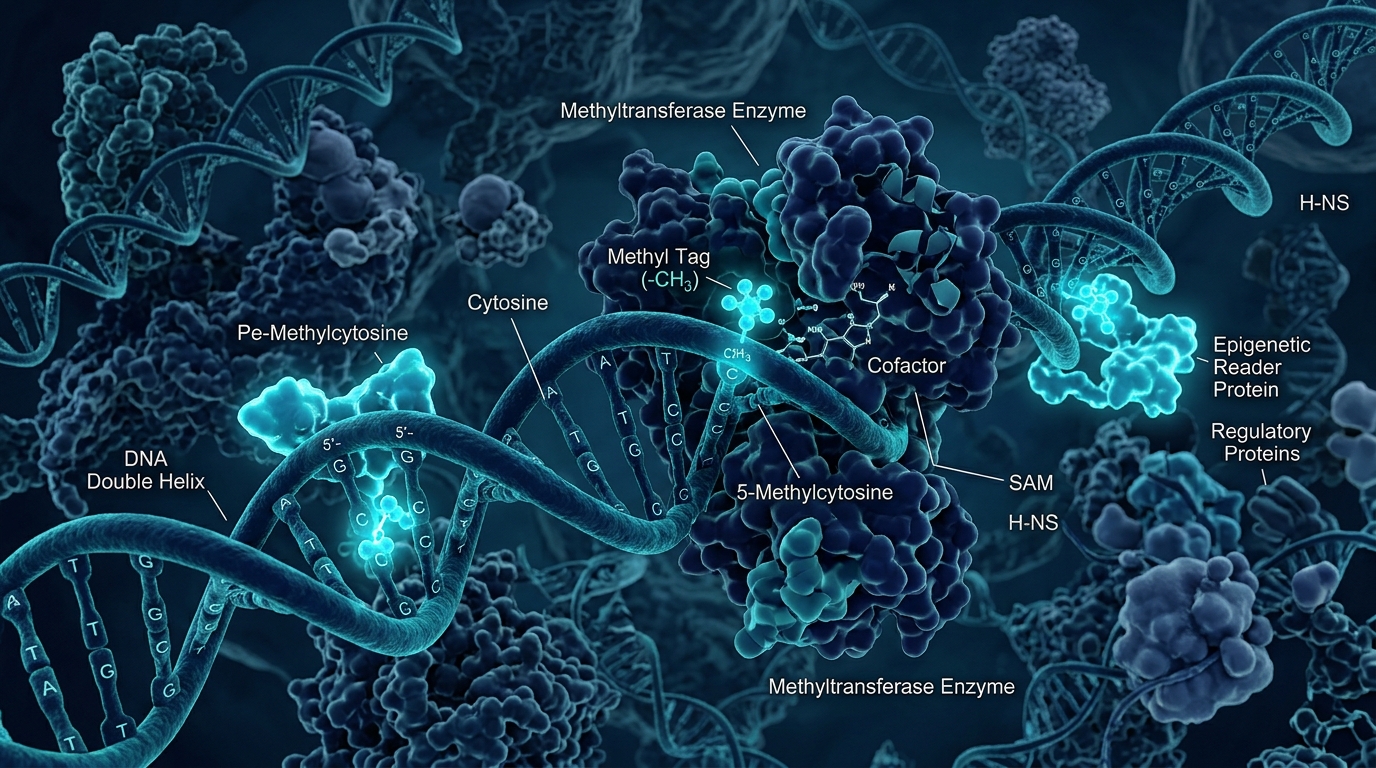
To place these chemical markers, bacteria employ specialized enzymes known as methyltransferases. Methyltransferases transfer a methyl group (-CH₃) from a universal methyl donor, typically S-adenosyl-L-methionine (SAM), to specific nucleic acid or protein substrates.
In biological systems, methyltransferases operate across several distinct macromolecular classes:
- DNA methyltransferases: Modify adenine or cytosine bases to control replication, repair, and transcription.
- Protein methyltransferases: Modify amino acid residues on histones (in eukaryotes) or nucleoid-associated proteins (in bacteria) to regulate chromatin architecture.
- RNA methyltransferases: Methylate mRNA, tRNA, and rRNA to fine-tune transcript stability and translation efficiency.
- Small-molecule methyltransferases: Modulate secondary metabolites, signaling molecules, and antibiotics.
In enteric bacteria like E. coli and Salmonella enterica, the most prominent epigenetic regulator is Dam (DNA adenine methyltransferase). Dam specifically recognizes the palindromic tetranucleotide sequence 5′-GATC-3′ and adds a methyl group to the N-6 position of the adenine residue.
       CH₃
        |
5′-G - A - T - C-3′
3′-C - T - A - G-5′
            |
           CH₃
Beyond orchestrating mismatch repair and timing chromosome replication, Dam acts as the master control switch for phase variation—the stochastic, reversible switching between alternative phenotypic states within an isogenic bacterial population.
Case Study 1: The pap Pili Switch in Uropathogenic E. coli
Uropathogenic E. coli (UPEC) causes debilitating urinary tract infections by deploying pyelonephritis-associated pili (P pili), encoded by the pap operon. These hair-like surface structures lock onto Gal(α1-4)Gal digalactoside receptors on uroepithelial cells.
However, continuous pili expression is costly:
- Pili production consumes substantial metabolic energy.
- Pili serve as potent antigens that alert host neutrophils and antibodies.
To balance tissue adherence with immune evasion, UPEC uses an epigenetic bistable switch to alternate between a piliated state (Phase ON) and a non-piliated state (Phase OFF).
The Epigenetic Mechanism
The regulatory promoter of the pap operon contains two regulatory 5′-GATC-3′ sites, designated GATC-I (proximal to the promoter) and GATC-II (distal):
- In the Phase OFF state: The global regulatory protein Lrp (leucine-responsive regulatory protein) binds to GATC-I, physically blocking Dam from methylating this site. Consequently, GATC-II becomes fully methylated while GATC-I remains unmethylated, repressing transcription.
- In the Phase ON state: The co-regulator PapI associates with Lrp, shifting its binding affinity from GATC-I to GATC-II. Dam can now access and methylate GATC-I, freeing the promoter and initiating high-level pili transcription.
During DNA replication, newly synthesized DNA strands are temporarily unmethylated on the nascent strand (hemi-methylated). This transient window provides the competitive opportunity for Lrp and PapI to re-bind or dissociate, allowing a small fraction of daughter cells to flip their pili status.
Case Study 2: The Salmonella That Lost Its Dam
What happens when a bacterial pathogen is stripped of its primary epigenetic writer?
Researchers generated mutant strains of Salmonella enterica serovar Typhimurium lacking the dam gene (Δdam mutants). The experimental consequences in animal models were striking:
- Profound Attenuation: Dam-deficient Salmonella mutants required a lethal dose 1,000 to 10,000 times higher than wild-type strains to establish lethal disease in mice.
- Defective Epithelial Invasion: Mutants showed severely impaired ability to invade M cells and intestinal enterocytes.
- Immunogenic Vaccine Candidates: Because Δdam mutants express a disordered array of surface antigens while remaining non-lethal, they functioned as live attenuated vaccines, conferring robust protective immunity against wild-type challenge.
In contrast, in organisms such as Vibrio cholerae and Yersinia pseudotuberculosis, dam is an essential gene; disrupting methylation compromises chromosome partition and causes cell death. This divergence highlights that epigenetic dependency varies significantly across microbial taxa.
Phasevarions: One Switch Controlling Entire Regulons
In traditional phase variation, a single switch controls a single surface appendage. In phasevarions (phase-variable regulons), a single epigenetic switch coordinates the simultaneous expression of dozens of unrelated genes across the entire bacterial chromosome.
                    ┌───> Outer Membrane Porins
                    ├───> Immune Evasion Capsule
Phasevarion (Mod) ──┼───> Iron Acquisition Systems
                    ├───> Heat Shock Chaperones
                    └───> Antibiotic Efflux Pumps
The modA Engine in Haemophilus influenzae
A paradigm phasevarion operates in Haemophilus influenzae. The bacterium carries a Type III DNA methyltransferase called ModA. Within the modA open reading frame lies a tract of simple sequence repeats (tetranucleotide 5′-AGTC-3′ repeats).
During DNA replication, slipped-strand mispairing gains or loses repeat units:
- Certain repeat counts keep modA in-frame (→ active methyltransferase produced).
- Other repeat counts cause a frameshift (→ truncated, inactive enzyme).
When ModA is active, it methylates specific recognition sequences throughout the chromosome. This differential methylation alters the binding of RNA polymerase and transcription factors at multiple independent promoters, coordinately shifting:
- Lipooligosaccharide (LOS) structure
- Heat shock protein expression
- Resistance to complement-mediated bactericidal killing
- Antimicrobial susceptibility profiles
Independent phasevarions have been identified across major human pathogens, including Neisseria meningitidis, Neisseria gonorrhoeae, Helicobacter pylori, Moraxella catarrhalis, and Streptococcus pneumoniae.
Clinical Implications: Vaccines and Antimicrobial Development
Appreciating bacterial epigenetics transforms how we design vaccines and antimicrobial agents:
- Selecting Stable Vaccine Targets: If an outer membrane antigen is regulated by a phasevarion, a vaccine targeting that protein will fail against Phase-OFF subpopulations. Epigenetic profiling ensures that candidate vaccine antigens are constitutively expressed across all methylation states.
- Epigenetic Inhibitors as Novel Antibiotics: Small molecules that selectively inhibit bacterial DNA methyltransferases without affecting human DNA methyltransferases (such as DNMT1 or DNMT3) could disrupt virulence networks, cripple colonization, and resensitize pathogens to host clearance.
Key Takeaways
- Epigenetic Memory Without Mutation: Bacteria leverage DNA methylation as reversible epigenetic memory to generate phenotypic heterogeneity within clonal populations.
- Coordinated Molecular Switches: The interplay between Dam methyltransferase, Lrp, and PapI controls the pap pili toggle in uropathogenic E. coli.
- Virulence Orchestration: Loss of Dam methyltransferase severely attenuates Salmonella virulence, illustrating that epigenetic coordination is essential for host adaptation.
- Phasevarions Modulate Global Physiology: Phase-variable methyltransferases act as master switches, simultaneously adjusting dozens of genes involved in immune evasion, nutrient acquisition, and antibiotic survival.