- 1 Plasmids
- 2 What Is Horizontal Gene Transfer (HGT)?
- 3 Plasmids vs. Other Mobile Genetic Elements
- 4 How Do Bacteria Become Multidrug Resistant?
- 5 The Role of Selective Pressure
- 6 Spread of Plasmid-Mediated Resistance
- 7 Why Are Resistance Plasmids So Successful?
- 8 Can Bacteria Lose Resistance Plasmids?
- 9 Study of Plasmids and Horizontal Gene Transfer
- 10 How Can We Control the Spread of Plasmid-Mediated Antibiotic Resistance?
- 11 Final Thoughts
Imagine a bacterium that has never encountered a particular antibiotic. Suddenly, it acquires a small piece of DNA from another bacterium, and that DNA carries a gene that allows it to survive the antibiotic. Within a short period, this previously susceptible bacterium may become resistant.
How does this happen? Unlike humans and other organisms that mainly pass genetic information from parents to offspring, bacteria have another remarkable way of exchanging genetic material. They can share DNA directly with other bacteria, acquire DNA from their surroundings, or receive genetic material through bacterial viruses. This process is called horizontal gene transfer (HGT).
One of the most important players in this process is the plasmid, which is a small, usually circular DNA molecule that can carry genes providing bacteria with useful survival advantages. Some plasmids carry antibiotic resistance genes, allowing bacteria to share resistance traits with other members of their microbial community. This is one of the reasons antibiotic resistances can spread so rapidly, sometimes even between different bacterial species.
In this blog, we will explore what plasmids are, how horizontal gene transfer works, how bacteria exchange antibiotic resistance genes, and why these tiny DNA molecules have become such a major concern in modern medicine.
Plasmids
Plasmids are small DNA molecules found in many bacteria. Unlike the main bacterial chromosome, plasmids generally exist as separate genetic elements and can replicate independently. Most naturally occurring bacterial plasmids are double-stranded DNA molecules, and many are circular, although linear plasmids also exist. Think of the bacterial chromosome as the main instruction manual containing essential information for the cell. Plasmids are like additional instruction booklets carrying genes that may provide extra advantages.
These additional genes can help bacteria:
- Resist antibiotics.
- Produce toxins or other virulence factors.
- Survive in stressful environments.
- Use unusual nutrients.
- Adapt to changing environmental conditions.
- Transfer genetic information to other bacteria.
Not every plasmid carries antibiotic resistance genes. Some carry genes associated with metabolism, virulence, or other biological functions. However, resistance plasmids are particularly important because they can help bacteria survive antibiotic exposure. A resistance plasmid, often called an R plasmid, carries one or more antibiotic resistance genes. For example, a plasmid may carry genes that provide resistance against:
- Beta-lactam antibiotics
- Tetracyclines
- Aminoglycosides
- Sulfonamides
- Quinolones
Some plasmids carry several resistance genes simultaneously. These are often associated with multidrug resistance (MDR). This means a single bacterial cell may acquire resistance to several antibiotic classes through the acquisition of one plasmid or a collection of mobile genetic elements.
What Is Horizontal Gene Transfer (HGT)?
Horizontal gene transfer is the movement of genetic material between organisms without requiring reproduction from parent to offspring. To understand the difference, consider two processes:
- Vertical gene transfer: A bacterial cell divides into two daughter cells. Each daughter receives a copy of the genetic information, including any resistance genes present in the parent.
- Horizontal gene transfer: A bacterium obtains genetic material from another bacterium or from its surrounding environment.
This second process is particularly important because it allows bacteria to acquire genes that they did not previously possess. It also means that antibiotic resistance is not limited to the gradual accumulation of mutations within a single bacterial lineage. Resistance genes can spread between bacterial populations through mobile genetic elements.
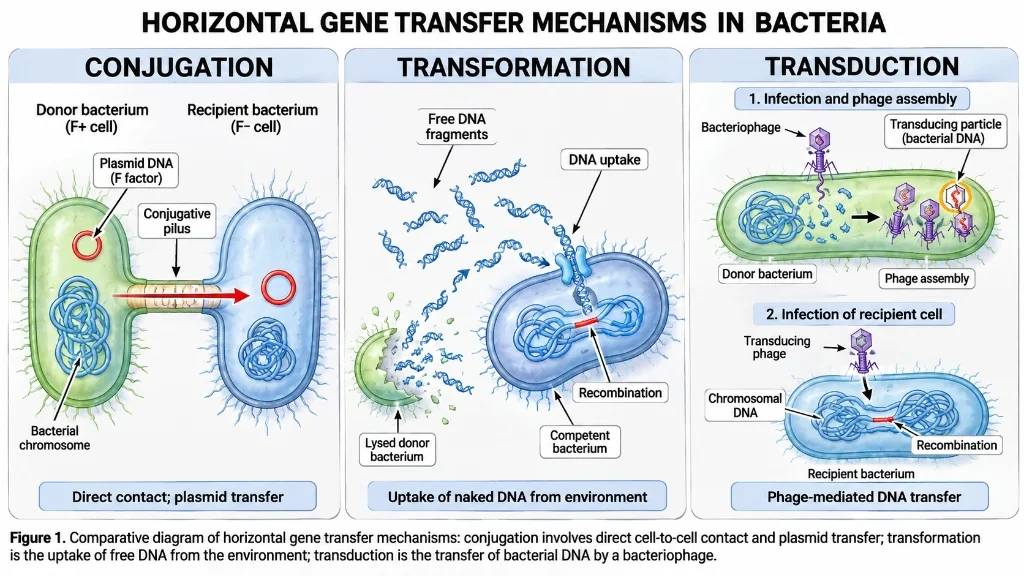 Figure 1. Comparative diagram of horizontal gene transfer mechanisms: conjugation involves direct cell-to-cell contact and plasmid transfer; transformation is the uptake of free DNA from the environment; transduction is the transfer of bacterial DNA by a bacteriophage.
There are three well-recognized mechanisms of horizontal gene transfer:
- Conjugation
- Transformation
- Transduction
Conjugation: Bacteria Sharing DNA Through Direct Contact
Conjugation is one of the most important mechanisms responsible for spreading plasmid-mediated antibiotic resistance. It involves the transfer of genetic material from a donor bacterium to a recipient bacterium through direct cell-to-cell contact. For conjugation, a donor bacterium must contain a conjugative plasmid that carries genes required for DNA transfer. It may also carry antibiotic resistance genes. The donor establishes contact with a recipient bacterium using a specialized transfer apparatus. In many Gram-negative bacteria, this involves a pilus or related cell-contact structure. A protein called relaxase recognizes a specific region of the plasmid known as the origin of transfer (oriT). Relaxase makes a cut in one DNA strand. One DNA strand is then transferred into the recipient cell through the conjugation machinery. Both donor and recipient synthesize complementary DNA strands, allowing the plasmid to be maintained as double-stranded DNA. If the plasmid is successfully established and expressed, the recipient may acquire the traits encoded by its new DNA, including antibiotic resistance.
One of the classic examples of bacterial conjugation involves the F (fertility) plasmid of Escherichia coli. The F plasmid carries genes involved in conjugation and can promote DNA transfer between bacterial cells. Bacteria containing a transferable F plasmid are traditionally described as F-positive (F⁺), while recipient cells lacking it are described as F-negative (F⁻). The F plasmid is an important model for understanding bacterial conjugation, although not all resistance plasmids behave exactly like the F plasmid.
Transformation: Bacteria Picking Up Free DNA
Transformation is another mechanism of horizontal gene transfer. Unlike conjugation, it does not require direct contact between two bacterial cells. Instead, certain bacteria can take up free DNA present in their surrounding environment. When bacterial cells die or break apart, they may release fragments of their DNA into the environment. Other bacteria can sometimes capture this extracellular genetic material by transformation. For transformation, a bacterial cell releases DNA into the surrounding environment. Another bacterium with the ability to take up extracellular DNA encounters these DNA fragments. The recipient takes up the DNA through specialized cellular mechanisms. The acquired DNA may be incorporated into the bacterial chromosome through recombination or, in suitable circumstances, maintained as a plasmid. If the DNA contains functional resistance genes and is successfully established, the recipient may acquire antibiotic resistance. Bacteria capable of naturally taking up extracellular DNA are called competent bacteria.
Examples of naturally competent bacteria include:
- Streptococcus pneumoniae
- Neisseria gonorrhoeae
- Haemophilus influenzae
- Certain species of Bacillus
Transformation is particularly important in bacterial evolution because it allows cells to obtain genetic information without direct contact with the original donor.
Transduction: Bacterial Viruses Carrying Genetic Information
Bacteria themselves can be infected by viruses known as bacteriophages. Interestingly, these viruses can sometimes transfer genetic material between bacterial cells. This process is called transduction. During certain bacteriophage replication cycles, bacterial DNA may accidentally become packaged into newly formed viral particles. When these particles infect another bacterium, they can deliver the previously acquired bacterial DNA. There are two major types of transductions:
A. Generalized transduction
During the assembly of new bacteriophages, fragments of bacterial DNA may accidentally be packaged instead of viral DNA. Because different regions of the bacterial chromosome can be transferred, this process is called generalized transduction.
B. Specialized transduction
Some bacteriophages integrate their genetic material into the bacterial chromosome. When the viral DNA later excises incorrectly, it may carry neighboring bacterial genes with it. Only particular bacterial genes near the integration site are typically transferred through this mechanism, which is why it is called specialized transduction.
Transduction can contribute to the spread of bacterial genes, including resistance determinants in some settings. However, plasmid-mediated conjugation is especially important in the dissemination of many resistance plasmids.
Plasmids vs. Other Mobile Genetic Elements
Plasmids are not the only genetic elements involved in antibiotic resistance. Several other mobile genetic elements help bacteria capture, rearrange, and move resistance genes.
| Genetic element | Main function | Importance in resistance |
|---|---|---|
| Plasmids | Extra-chromosomal DNA molecules that replicate independently | Can carry and transfer resistance genes |
| Transposons | DNA segments that move between genetic locations | Can move resistance genes between chromosomes and plasmids |
| Integrons | Genetic systems that capture and express gene cassettes | Can accumulate multiple resistance determinants |
| Insertion sequences | Small mobile DNA elements | Can alter gene expression or facilitate DNA rearrangements |
| Bacteriophages | Viruses that infect bacteria | Can transfer bacterial DNA through transduction |
How Do Bacteria Become Multidrug Resistant?
One of the most concerning features of resistance plasmids is their ability to carry multiple resistance determinants. For example, a single plasmid may contain genes associated with resistance to beta-lactams, aminoglycosides, tetracyclines, and sulfonamides. When a bacterium acquires such a plasmid, it may gain resistance to several antibiotic classes at once. This is one route through which multidrug-resistant bacteria emerge. Some commonly studied resistance genes include:
| Resistance gene | Associated resistance |
|---|---|
| blaCTX-M | Extended-spectrum beta-lactam resistance |
| blaNDM | New Delhi metallo-beta-lactamase-mediated carbapenem resistance |
| blaKPC | KPC-type carbapenem resistance |
| mecA | Methicillin resistance in staphylococci |
| tetA | Tetracycline resistance through efflux |
| qnr genes | Reduced susceptibility to quinolones through target protection |
| mcr-1 | Plasmid-mediated colistin resistance |
These genes are not all restricted to plasmids, and their genetic locations can vary. However, several are important examples of resistance determinants associated with mobile genetic elements.
The Role of Selective Pressure
Antibiotic exposure can create conditions that favor bacteria carrying resistance genes.
Imagine a bacterial population containing two groups:
- Antibiotic-susceptible bacteria.
- Bacteria carrying a resistance plasmid.
When an antibiotic is used, susceptible bacteria may be inhibited or killed, while resistant bacteria have a survival advantage. The resistant bacteria can then multiply and pass their resistance genes to their descendants. If the plasmid is transferable, it may also spread to other bacteria. This process is called selection for antibiotic resistance. It is important to understand that antibiotics do not necessarily cause bacteria to deliberately develop resistance. Instead, antibiotic exposure selects for bacteria that already possess, or subsequently acquire, genetic changes that provide a survival advantage.
Spread of Plasmid-Mediated Resistance
Plasmid-mediated resistance is not restricted to hospitals. Bacteria occupy interconnected environments, and resistance genes can circulate among human-associated, animal-associated, and environmental bacterial populations.
Hospitals and Healthcare Settings
Hospitals provide environments where many bacterial species encounter antibiotics, patients, healthcare surfaces, and medical equipment. Resistant bacteria and their mobile genetic elements can circulate between patients and healthcare-associated environments.
Agriculture and Animal Production
Antibiotic use in animal production can create selection pressure favoring resistant bacteria. These bacteria and their resistance genes may spread through animal-associated environments, food chains, and other routes.
Wastewater and the Environment
Wastewater can contain bacteria originating from human, animal, and industrial sources. It can also bring together different bacterial populations, creating opportunities for genetic exchange.
The Human Gut Microbiome
The human intestine contains an enormous and diverse bacterial community. Because many bacteria live in close proximity, the gut can provide opportunities for horizontal gene transfer. Commensal bacteria may carry resistance genes that can potentially move into other bacterial populations, including pathogens. This is why antibiotic resistance is considered a One Health problem involving human health, animal health, and the environment.
Why Are Resistance Plasmids So Successful?
If carrying additional DNA requires energy, why do bacteria continue to maintain resistance plasmids? The answer is that plasmids have several mechanisms that help them persist.
Selective Advantage
When antibiotics are present, bacteria carrying useful resistance genes may survive better than susceptible bacteria.
Plasmid Maintenance Systems
Some plasmids contain partitioning systems that help ensure their distribution into daughter cells during bacterial division. Others contain toxin–antitoxin systems that can contribute to plasmid maintenance.
Horizontal Transfer
Conjugative plasmids can move between bacterial cells, allowing resistance genes to spread beyond the original bacterial lineage.
Adaptation to the Host
Over time, plasmids and their bacterial hosts can adapt to one another. Mutations and genetic changes may reduce the fitness cost of plasmid carriage or improve plasmid persistence. This means that even when resistance genes are not immediately needed, some plasmids may remain in bacterial populations.
Can Bacteria Lose Resistance Plasmids?
Yes. Plasmid carriage can impose a fitness cost because maintaining and replicating extra DNA requires cellular resources. When antibiotic selection pressure is absent, some bacteria may gradually lose plasmids, particularly if plasmid maintenance is unstable and plasmid-free cells grow faster. However, plasmid loss is not guaranteed. Some plasmids contain maintenance systems, and compensatory mutations can reduce the cost of carrying them. Consequently, resistance may persist even when antibiotic exposure decreases. This is one reason controlling antibiotic resistance is more complicated than simply reducing antibiotic use.
Study of Plasmids and Horizontal Gene Transfer
Modern microbiology uses several techniques to investigate plasmid structure, resistance genes, and genetic transfer.
- Plasmid Isolation: Plasmid DNA can be extracted from bacterial cultures using plasmid extraction methods. Researchers can then assess plasmid size, concentration, purity, and genetic content.
- Polymerase Chain Reaction (PCR): PCR can detect specific antibiotic resistance genes. For example, researchers may investigate the presence of blaNDM, blaCTX-M, or mcr-1 in bacterial isolates. However, detecting a resistance gene does not by itself establish whether it is located on a plasmid or chromosome.
- Gel Electrophoresis: Agarose gel electrophoresis can help visualize DNA fragments and provide preliminary information about plasmid preparations. Plasmid topology can affect migration, so gel position alone should not be treated as a reliable measurement of plasmid size.
- Whole-Genome Sequencing: Whole-genome sequencing provides detailed information about bacterial genetic content. Short-read sequencing can identify resistance genes and genetic relationships, while long-read sequencing can help resolve plasmid structures and determine where resistance genes are located. Combining both approaches can provide particularly useful information about complex plasmids.
- Conjugation Studies: Researchers can investigate whether resistance-associated genetic material is transferable between bacterial populations using appropriately designed laboratory conjugation assays. Such studies help distinguish transferable resistance from resistance that remains restricted to the original bacterial strain.
How Can We Control the Spread of Plasmid-Mediated Antibiotic Resistance?
Because plasmid-mediated resistance involves several interconnected biological and environmental processes, controlling it requires more than one strategy. Important approaches include:
- Responsible antibiotic prescribing.
- Avoiding unnecessary antibiotic use.
- Strong infection prevention and control in hospitals.
- Appropriate antimicrobial stewardship in animal production.
- Monitoring resistance genes through molecular surveillance.
- Genomic surveillance of clinically important plasmids.
- Improved wastewater and environmental monitoring.
- Development of new antimicrobial treatments and alternative therapies.
Researchers are also investigating approaches that directly target plasmids, interfere with their transfer, or reduce their persistence. Although these strategies are promising research areas, no single plasmid-control approach currently provides a universal solution.
Final Thoughts
Plasmids are small DNA molecules, but their impact on bacterial evolution and public health is enormous. Through horizontal gene transfer, bacteria can exchange genetic information and acquire traits that help them survive changing environments. When plasmids carry antibiotic resistance genes, this exchange can accelerate the spread of resistance across bacterial populations.
Conjugation, transformation, and transduction represent three major routes of horizontal gene transfer, while plasmids, transposons, and integrons work together to capture, maintain, and disseminate resistance determinants. The most important lesson is that antibiotic resistance is not simply a problem of individual bacteria becoming stronger. It is also a problem of genetic information moving through entire microbial communities. A bacterium does not always need to evolve resistance on its own. Sometimes, it can acquire the genetic tools for survival from another bacterium.