Introduction
Accurate microbial identification is essential in clinical diagnostics, infectious disease research, and epidemiological surveillance. Traditionally, laboratories have relied on culture and biochemical methods to identify microorganisms. However, sequencing technologies have introduced more precise approaches for microbial identification and genomic characterization.
Among these technologies, Sanger sequencing and next-generation sequencing (NGS) are widely used. While Sanger sequencing focuses on specific genetic markers, NGS allows the parallel analysis of multiple DNA fragments, providing broader genomic information.
But which approach is better for microbial identification? The answer depends on the organism, research objective, and level of genetic resolution required.
Sanger Sequencing: Targeted Microbial Identification
Sanger sequencing, also known as the chain-termination method, is a first-generation sequencing technology developed by Frederick Sanger and colleagues. It uses fluorescently labelled dideoxynucleotides (ddNTPs) to terminate DNA synthesis at specific positions. The resulting DNA fragments are separated through capillary electrophoresis to determine their nucleotide sequence.
In microbiology, Sanger sequencing is commonly used to analyse specific genetic markers, including:
- 16S rRNA gene: For bacterial identification.
- ITS regions: For fungal identification.
- D1/D2 region of 28S rRNA: For identification of selected yeasts and fungi.
The resulting sequences are compared against reference databases, such as NCBI BLAST, to identify the closest matching organisms.
However, closely related bacterial species may share highly similar 16S rRNA sequences, limiting reliable species-level identification in certain groups.
Next-Generation Sequencing (NGS)
NGS refers to high-throughput sequencing technologies that enable millions of DNA fragments to be sequenced in parallel. For microbial identification, two important applications are:
- Targeted amplicon sequencing: Analyses selected genetic markers, such as bacterial 16S rRNA or fungal ITS regions, allowing multiple samples or targets to be investigated efficiently.
- Whole-genome sequencing (WGS): Analyses the complete genome of a microbial isolate, providing information for species identification, strain differentiation, phylogenetic analysis, and detection of antimicrobial resistance-associated genes.
Commonly used platforms include Illumina short-read sequencing and Oxford Nanopore long-read sequencing. These technologies have complementary characteristics, and combining them through hybrid sequencing can improve bacterial genome assembly. Oxford Nanopore is generally classified as a third-generation sequencing technology rather than conventional second-generation NGS.
Advantages and Limitations
Sanger sequencing
Its major advantage is simplicity. It is suitable for targeted identification of individual microbial isolates, produces high-quality sequence data, and generally requires less computational infrastructure.
However, it provides information only about the selected genetic region. It may also struggle to distinguish closely related species and interpret mixed microbial DNA templates.
NGS
NGS provides considerably more genomic information than targeted Sanger sequencing. Whole-genome sequencing enables higher-resolution strain comparisons, investigation of genetic relationships, and identification of known antimicrobial resistance-associated determinants.
Its limitations include higher infrastructure requirements, sequencing costs, substantial data-processing requirements, and the need for appropriate bioinformatics expertise. Furthermore, detecting a resistance gene does not necessarily establish phenotypic antimicrobial resistance. [3]
Sanger Sequencing vs. NGS: Quick Comparison
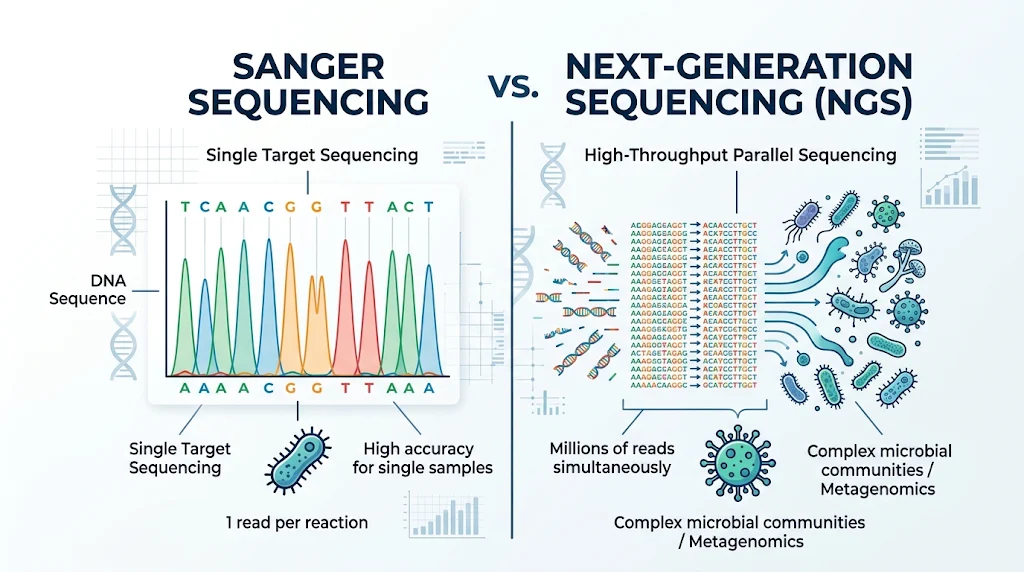
Figure 1. Sanger Sequencing vs. NGS: Microbial Identification Workflows
The figure illustrates the differences between targeted marker sequencing using Sanger and high-throughput sequencing approaches, including targeted amplicon sequencing and whole-genome sequencing.
Which Method Should You Choose?
The choice depends on the scientific question.
Sanger sequencing is suitable when:
- Identifying individual bacterial or fungal isolates.
- A specific genetic marker provides sufficient taxonomic resolution.
- Targeted sequence confirmation is required.
NGS is suitable when:
- Whole-genome characterization is required.
- Higher-resolution strain differentiation is needed.
- Investigating outbreaks and genetic relationships between isolates.
Conclusion
Both Sanger sequencing and NGS have important roles in modern microbial identification. Sanger sequencing remains a practical approach for targeted identification of individual microbial isolates, whereas NGS provides broader genomic information and supports detailed characterization of microbial genomes.
However, NGS is not necessarily the better option for every identification task. The appropriate technology depends on the research objective, required resolution, available resources, and complexity of the sample. Ultimately, Sanger sequencing remains valuable for targeted identification, while NGS is particularly useful when comprehensive genomic characterization is required.
| Feature | Sanger Sequencing | NGS |
|---|---|---|
| Sequencing generation | First generation | High-throughput sequencing |
| Throughput | Low | High |
| Sequencing approach | Targeted | Parallel sequencing |
| Genomic coverage | Selected regions | Targeted regions or whole genome |
| Species identification | Marker-based | Marker-based or genome-based |
| Strain differentiation | Limited with individual markers | Higher resolution using WGS |
| Bioinformatics requirements | Relatively low | Relatively high |
| Main application | Targeted microbial identification | Genomic characterization and strain analysis |