- 1 Incubation Period
- 2 What Happens Inside the Body During the Silent Phase?
- 3 Why Don’t We Feel Sick Immediately After Infection?
- 4 Can You Spread a Virus During the Incubation Period?
- 5 Incubation Period vs. Eclipse Period
- 6 Why Do Different Viruses Have Different Incubation Periods?
- 7 Can Laboratory Tests Detect a Virus Before Symptoms Appear?
- 8 What Happens When the Incubation Period Ends?
- 9 Why Is Understanding the Incubation Period Important?
- 10 Conclusion
Have you ever wondered what happens inside your body after catching a virus but before you actually feel sick? You might have been exposed to an infected person, inhaled virus-containing particles, or touched a contaminated surface. A few hours or days pass, and everything seems completely normal. You continue working, eating, exercising, and going about your daily routine. But inside your body, something very different may be happening. The virus may already have entered susceptible cells, released its genetic material, and started producing new viral components. At the same time, your immune system is attempting to recognize the infection and control its spread. This period between becoming infected and developing the first symptoms is known as the incubation period. It is often described as the silent phase of an infection because the person may feel perfectly healthy even though the virus is already interacting with the body’s cells and immune defenses.
But why does it take time for symptoms to appear? Can a person transmit a virus during this period? And what exactly is happening at the cellular level? Let’s explore the biology behind this fascinating stage of viral infection.
Incubation Period
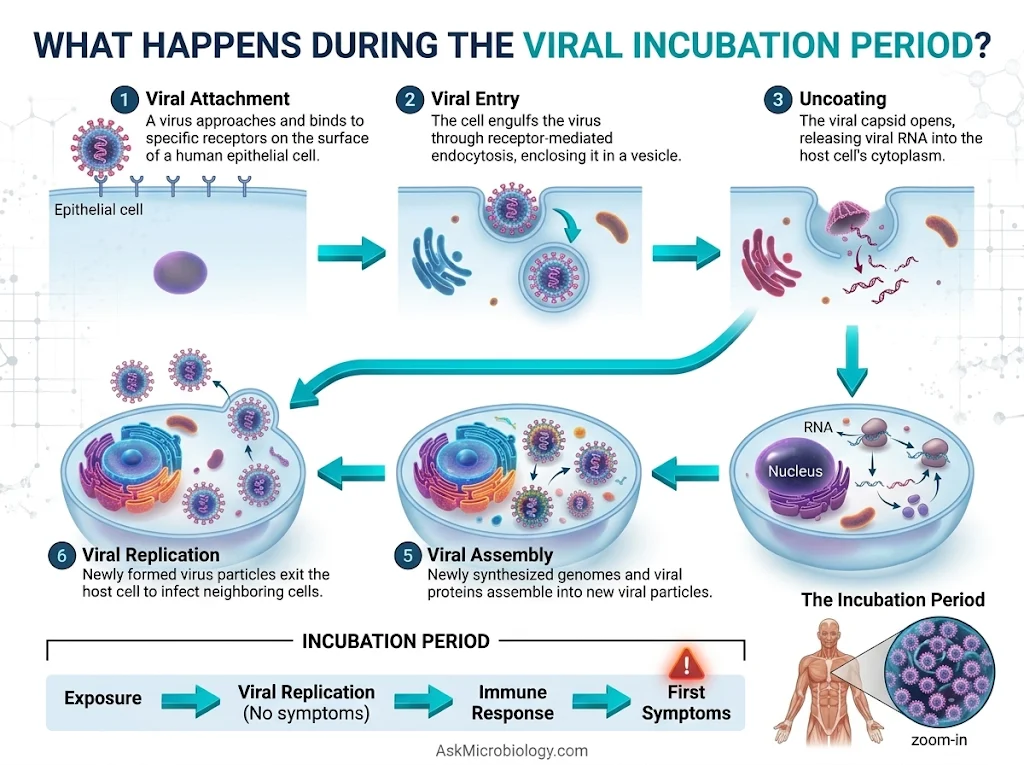
The incubation period is the time between the initial infection and the appearance of the first signs or symptoms of disease. During this interval, the virus may establish itself at the site of entry, multiply within susceptible cells, and sometimes spread to other tissues. The important thing to understand is that infection begins before symptoms appear. For example, after inhaling influenza virus, viral particles may reach susceptible epithelial cells lining the respiratory tract. The virus can enter these cells and begin its replication cycle before the infected person experiences fever, cough, or muscle aches.
The duration of incubation varies considerably depending on several factors:
- The type of virus involved.
- The amount of virus entering the body.
- The route of infection.
- The susceptibility of target cells.
- The person’s immune status.
- The speed at which the virus replicates and spreads.
There is no universal incubation period for all viral infections. Some respiratory viruses produce symptoms within a few days, whereas other infections may remain clinically silent for weeks or even months.
What Happens Inside the Body During the Silent Phase?
Although the infected person may not notice anything unusual, several biological processes can already be taking place. Let’s follow the infection step by step.
Step 1: The Virus Enters the Body
Every viral infection begins with exposure and successful entry into a susceptible host.
Depending on the virus, entry may occur through:
- The respiratory tract.
- The gastrointestinal tract.
- Broken skin or direct inoculation.
- The genital and urinary tracts.
- Insect bites.
- Blood or other infected biological materials.
Once inside, viral particles encounter cells that contain the specific receptors or cellular conditions required for infection.
Not every virus can infect every cell. This preference for particular cell types is known as tissue tropism. For instance, influenza viruses primarily infect susceptible respiratory epithelial cells, while hepatitis B virus has a strong tropism for liver cells.
Step 2: Attachment, Entry, and Uncoating
After reaching a suitable cell, the virus attaches to specific cellular receptors or other surface molecules. This interaction is important because it determines whether the virus can enter the cell. Following attachment, viral entry may occur through membrane fusion, endocytosis, or other virus-specific mechanisms. Once inside, the viral capsid is removed or disassembled sufficiently to release the viral genome. This process is known as uncoating. At this point, the virus has delivered its genetic material into the host cell and can begin the molecular processes required for replication.
Step 3: Viral Replication Begins
This is where the infection becomes particularly interesting from a molecular biology perspective. Viruses cannot reproduce independently. They depend on host cells to provide the cellular machinery and resources needed to produce new viral components. Depending on the virus, its genome may be DNA or RNA. Some viruses use host-cell enzymes to replicate their genetic material, while others carry or encode their own replication enzymes.
For example:
- Influenza virus uses an RNA-dependent RNA polymerase to replicate its RNA genome.
- SARS-CoV-2 uses a viral RNA-dependent RNA polymerase to produce new RNA molecules.
- Herpes simplex virus uses a viral DNA polymerase to replicate its DNA genome.
- HIV uses reverse transcriptase to convert its RNA genome into DNA.
As replication progresses, viral proteins and nucleic acids accumulate inside infected cells. The cell gradually becomes a production site for new viral particles.
Step 4: The Immune System Detects the Infection
While viruses are replicating, the immune system is not simply waiting for symptoms to appear. Cells of the innate immune system contain pattern-recognition receptors (PRRs) that recognize molecular features associated with viral infection. These receptors detect viral components, including certain forms of RNA and DNA. One of the most important responses involves the production of type I interferons, particularly IFN-α and IFN-β. Interferons help establish an antiviral state in nearby cells by activating genes that interfere with different stages of viral replication.
Other immune responses may also become activated, including:
- Natural killer (NK) cell activity.
- Inflammatory cytokine production.
- Recruitment of immune cells to infected tissues.
- Activation of antigen-presenting cells.
- Initiation of adaptive immune responses.
Interestingly, some viruses have evolved mechanisms that interfere with interferon signaling and other antiviral defenses. This can allow them to replicate for some time before the infection produces noticeable symptoms.
Step 5: The Virus May Spread to Other Tissues
Not every viral infection remains limited to the original site of entry. Some viruses multiply locally, while others spread through the lymphatic system, bloodstream, or peripheral nerves. For example, after entering through the respiratory or gastrointestinal tract, certain viruses can reach lymphoid tissues and subsequently enter the bloodstream. This process is known as viremia. Depending on the virus, infected blood cells or circulating viral particles may transport the infection to additional organs. The virus may then establish infection in specific target tissues. This stage is particularly important because symptoms often develop when viral replication, tissue damage, or the immune response reaches a level that produces clinically noticeable changes.
Why Don’t We Feel Sick Immediately After Infection?
This is one of the most interesting questions in virology. If viruses are already multiplying inside our cells, why don’t we experience fever, fatigue, or other symptoms immediately? The answer is that the presence of a virus does not automatically produce noticeable illness. Many symptoms associated with viral infections are caused not only by direct viral damage but also by the body’s immune response. For example, fever is influenced by inflammatory signaling molecules called pyrogens. These molecules affect the hypothalamus, the region of the brain responsible for regulating body temperature. Similarly, fatigue, muscle aches, and general discomfort can result from inflammatory mediators released during infection.
During the early stages, viral replication may be limited, immune activation may remain relatively localized, or viral proteins may interfere with antiviral signaling. Consequently, the infection may remain clinically silent for some time. As viral activity and immune responses increase, the person may eventually develop symptoms. However, this relationship is not identical for every virus. Some infections produce symptoms through direct tissue damage, while others are strongly influenced by immune-mediated inflammation.
Can You Spread a Virus During the Incubation Period?
Yes, and this is one of the most important public health aspects of the incubation period. Some viruses can be transmitted before an infected person develops symptoms. This is known as presymptomatic transmission.
The distinction is important:
- Presymptomatic infection: The person is infected and can transmit the virus before symptoms begin.
- Asymptomatic infection: The person is infected but never develops noticeable symptoms.
- Symptomatic infection: The person develops recognizable signs or symptoms of illness.
Not every virus follows the same transmission pattern. For example, influenza can be transmitted approximately one day before symptoms develop. Measles transmission can also begin before the characteristic rash appears. SARS-CoV-2 demonstrated that substantial transmission can occur before symptom onset, contributing to its rapid spread during the COVID-19 pandemic. However, an infected person is not automatically contagious throughout the entire incubation period. Transmission depends on whether infectious virus is being shed, the route of transmission, and the timing of exposure. This is why symptom-based screening alone cannot identify every infected individual.
Incubation Period vs. Eclipse Period
These two terms are often confused, especially by microbiology students. Although both describe periods during viral infection, they refer to different biological events.
Incubation period
The time between infection and the appearance of the first clinical symptoms.
Eclipse period
A stage in the viral replication cycle during which newly formed infectious viral particles cannot yet be detected inside the infected cell.
During the eclipse period, the virus has entered the cell and undergone uncoating. Its genetic material is being replicated, and viral proteins are being synthesized, but mature infectious progeny particles have not yet appeared. The eclipse period is therefore a cellular virology concept, whereas the incubation period is a clinical and epidemiological concept.
| Feature | Incubation Period | Eclipse Period |
|---|---|---|
| Main concept | Development of clinical symptoms | Production of infectious viral particles |
| Begins | Following infection | After viral entry and uncoating |
| Ends | At symptom onset | When newly formed infectious virions become detectable |
| Duration | Hours to months, depending on virus | Usually much shorter and virus-specific |
| Used in | Clinical medicine and epidemiology | Virology and viral replication studies |
Understanding this difference is particularly useful when studying viral growth curves and one-step growth experiments.
Why Do Different Viruses Have Different Incubation Periods?
If all viruses enter host cells and use cellular machinery to replicate, why do some cause symptoms within a day while others take weeks? Several biological and epidemiological factors explain this difference.
Viral replication rate
Some viruses replicate rapidly, while others require more time to produce sufficient viral material to cause disease.
Target tissue
Viruses that cause disease close to their entry site may produce symptoms relatively quickly. Viruses that must spread to distant organs may require additional time.
Immune response
The strength, timing, and effectiveness of innate and adaptive immune responses influence when symptoms develop.
Infectious dose
The amount of virus involved in exposure can influence infection dynamics, although the relationship varies between viruses and should not be treated as a simple rule.
Host factors
Age, immune status, previous exposure, vaccination, and underlying health conditions can influence the course of infection.
Here are some approximate incubation periods for familiar viral infections:
These are general estimates, not fixed biological deadlines. Actual incubation periods vary between individuals and outbreaks.
| Viral infection | Typical incubation period |
|---|---|
| Influenza | 1–4 days |
| Common cold (rhinovirus) | 1–3 days |
| COVID-19 | Varies by variant; often several days |
| Measles | Approximately 7–14 days to initial symptoms; rash usually appears later |
| Hepatitis A | Approximately 15–50 days |
| Chickenpox | Approximately 10–21 days |
| Ebola virus disease | 2–21 days |
Can Laboratory Tests Detect a Virus Before Symptoms Appear?
Yes. Modern diagnostic techniques can sometimes identify viral infections before clinical symptoms develop. The most commonly used approaches include molecular and immunological methods.
RT-PCR and RT-qPCR
These techniques detect specific viral RNA sequences. If viral genetic material is present in the collected sample at a detectable concentration, molecular testing may identify infection before symptoms appear. However, a negative result does not always exclude early infection. Viral concentrations may still be below the detection limit, or the selected sample may not contain sufficient viral material.
Antigen detection
Antigen-based tests identify specific viral proteins. Their sensitivity depends on the amount of antigen present and the performance of the particular assay.
Serological testing
Serological assays detect antibodies produced by the immune system in response to infection. However, antibodies may not become detectable until days or weeks after infection. Therefore, serology is not necessarily useful for identifying the earliest stages of an acute infection. This distinction is important: a test may be capable of detecting infection during the incubation period, but its ability to do so depends on the virus, the timing, the specimen, and the assay used.
What Happens When the Incubation Period Ends?
The incubation period ends when the first recognizable signs or symptoms of the disease appear. However, the transition is not always dramatic. Some infections begin with vague symptoms such as:
- Mild fatigue.
- Headache.
- Low-grade fever.
- Muscle discomfort.
- Reduced appetite.
- General weakness.
These early symptoms may represent the beginning of the prodromal stage. As the infection progresses, more characteristic symptoms may develop. For example, a person with influenza may initially experience fatigue and mild discomfort before developing fever, cough, headache, and muscle aches. The clinical outcome depends on several factors, including viral replication, tissue involvement, immune responses, and the ability of the host to control infection. Some infections resolve without significant illness, while others may progress to severe disease or persist for prolonged periods.
Why Is Understanding the Incubation Period Important?
The incubation period is not just an interesting biological concept. It has important applications in clinical medicine, epidemiology, and infectious disease control.
- Outbreak investigation: Epidemiologists use incubation periods to estimate possible exposure windows and identify links between infected individuals.
- Quarantine and monitoring: Public health authorities consider incubation periods when determining how long exposed individuals should be monitored.
- Diagnostic planning: Understanding when viral material becomes detectable helps laboratories select appropriate testing windows.
- Infection prevention: Awareness of presymptomatic transmission supports preventive measures that do not depend entirely on visible symptoms.
- Vaccine and antiviral research: Understanding early viral replication and immune responses helps researchers identify opportunities for intervention before severe disease develops.
In other words, studying the silent phase of infection helps scientists understand not only how viruses establish disease but also how infections can be detected and controlled.
Conclusion
The incubation period may appear silent from the outside, but inside the body it can be a highly active biological stage. During this time, viruses may enter susceptible cells, release their genetic material, replicate, produce new viral components, and sometimes spread to other tissues. Meanwhile, the immune system is working to recognize and control the infection. The absence of symptoms does not necessarily mean the absence of viral activity. Some infections can even be transmitted before the infected person realizes that they are sick. Understanding the incubation period therefore provides an important connection between molecular virology, immunology, clinical diagnosis, and epidemiology. The next time someone asks why a person can feel completely healthy after exposure to a virus, remember that the body may already be responding to an infection that has not yet announced itself.