- 1 What Makes Fetal Bovine Serum So Important in Cell Culture?
- 2 The Problem With FBS: Why Researchers Are Looking for Alternatives
- 3 What Exactly Is Serum-Free Media?
- 4 Serum-Free, Chemically Defined, and Xeno-Free Media: Are They the Same?
- 5 What Does This Change Mean for Different Cell Culture Applications?
- 6 Does Serum-Free Media Always Improve Cell Growth?
- 7 How to Transition From FBS to Serum-Free Media in the Laboratory
- 8 Challenges That Still Limit the Complete Replacement of FBS
- 9 The Future of Cell Culture: Moving Toward More Controlled Systems
- 10 Final Thoughts
For decades, fetal bovine serum (FBS) has been one of the most important ingredients in mammalian cell culture. Whether researchers are growing cancer cell lines, maintaining stem cells, producing viral vectors, or developing new therapies, FBS has traditionally been added to culture media to support cell growth and survival. It provides cells with a complex mixture of growth factors, hormones, proteins, lipids, vitamins, and other nutrients that help them grow under laboratory conditions. However, the way researchers approach cell culture is gradually changing. More laboratories are moving away from traditional serum-containing media and exploring serum-free alternatives. This shift is not simply about replacing one laboratory reagent with another. It reflects a broader effort to make cell culture more reproducible, controlled, ethical, and suitable for modern biotechnology applications. So, why is fetal bovine serum losing its position as the standard supplement? And more importantly, what does this transition mean for researchers working with cell cultures? Let’s talk about this.
What Makes Fetal Bovine Serum So Important in Cell Culture?
To understand why researchers are moving away from FBS, it is important to first understand why it became so widely used. Fetal bovine serum is collected from bovine fetuses and contains hundreds of biologically active components. Unlike basic culture media, which mainly provide essential salts, amino acids, glucose, and vitamins, FBS supplies additional substances that support several cellular processes. For example, it contains growth factors that stimulate cell proliferation, albumin that helps transport different molecules, attachment factors that support cell adhesion, and hormones that influence cellular metabolism and function. This complex composition makes FBS particularly useful when growing cells that require additional support.
Many commonly used cell lines, including HEK293, CHO, and various cancer cell lines, have historically been maintained in media supplemented with FBS. However, there is an important limitation hidden behind this convenience: researchers do not know the exact composition of every batch of serum. And that uncertainty becomes a major problem when experiments require consistent and reproducible results.
The Problem With FBS: Why Researchers Are Looking for Alternatives
Although FBS supports cell growth effectively, it introduces several challenges that can affect laboratory experiments and large-scale production.
Batch-to-Batch Variation
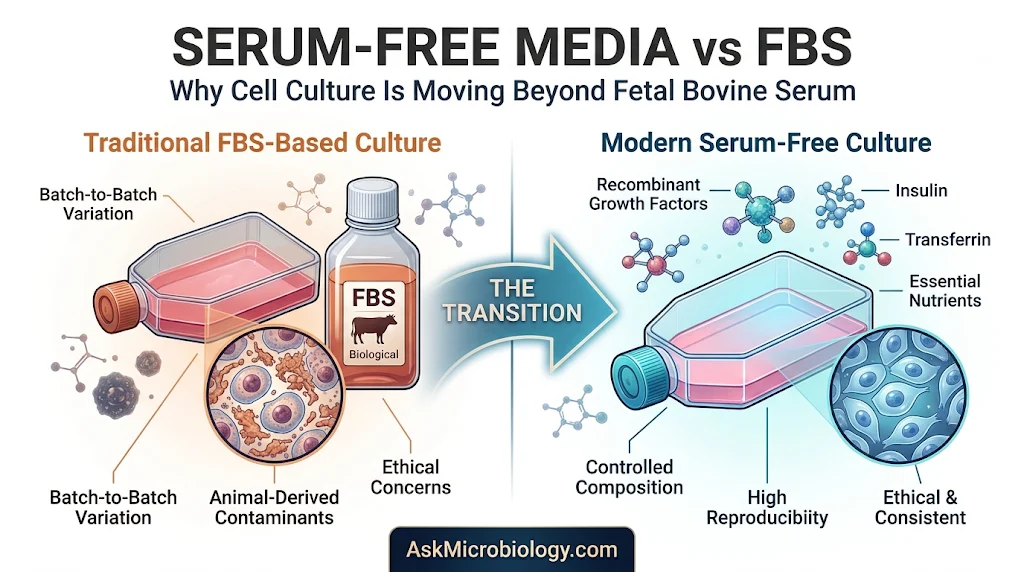
One of the biggest limitations of FBS is its natural variability. Serum is a biological product, meaning its composition can differ depending on factors such as the animal source, collection conditions, processing methods, and manufacturing procedures. Consequently, two different batches of FBS may not support cell growth in exactly the same way. Imagine maintaining the same cell line for several months. Everything remains unchanged: the culture medium, incubation temperature, seeding density, and passage schedule. However, after opening a new bottle of FBS, you suddenly notice slower cell growth or changes in cell morphology. This does not necessarily mean something went wrong with your technique. The new serum batch may simply contain different concentrations of growth-promoting or inhibitory components. Such variation can complicate experimental comparisons, especially in studies involving gene expression, drug screening, cell differentiation, and immunological responses.
Ethical Concerns Associated with Serum Collection
Another major reason behind the shift toward serum-free media is animal welfare. FBS is obtained from bovine fetuses, and its production raises ethical concerns regarding animal use and serum collection procedures. As biotechnology continues to develop, researchers are increasingly interested in reducing their dependence on animal-derived biological materials. Serum-free media provide an opportunity to move toward more ethically controlled cell culture systems without necessarily compromising cellular performance. Although serum-free formulations are not automatically animal-component-free, they can be designed without fetal bovine serum and, in some cases, without any animal-derived ingredients.
Risk of Contamination
Biological materials always carry some level of contamination risk, and FBS is no exception. Depending on its source and processing, serum may introduce unwanted biological agents, including viruses, mycoplasma, endotoxins, or other contaminants. Commercial serum manufacturers use filtration, testing, and quality-control procedures to reduce these risks. However, no biological supplement should be considered completely free from contamination concerns. This becomes particularly important in applications involving therapeutic cell production, vaccine development, and biopharmaceutical manufacturing. Removing serum from the culture system can help reduce certain contamination risks associated with animal-derived materials, although serum-free media still require appropriate sterility testing and quality control.
Uncontrolled Effects on Cellular Behavior
Perhaps one of the most overlooked problems with FBS is its ability to influence cellular behavior beyond simply supporting growth. Serum contains numerous signaling molecules, hormones, cytokines, and growth factors. These components can activate cellular pathways and alter gene expression. For example, when researchers investigate how a particular treatment affects cancer cell proliferation, the growth factors naturally present in FBS may also influence the same signaling pathways. As a result, separating the effect of the experimental treatment from the background influence of serum can become difficult. This is especially relevant in studies involving cell signaling, metabolism, differentiation, and drug response. And this is where serum-free culture systems offer an important advantage: they allow researchers to control the components that cells receive more precisely.
What Exactly Is Serum-Free Media?
Serum-free media are specially formulated culture media that do not contain serum, including fetal bovine serum. However, this does not mean that these media contain only basic nutrients. Instead, serum-free formulations provide selected supplements that replace the functions normally performed by serum.
Depending on the cell type and application, these supplements may include:
- Recombinant growth factors such as EGF, FGF, and insulin.
- Transferrin for iron transport.
- Selenium and other essential trace elements.
- Defined amino acids and vitamins.
- Lipids and cholesterol.
- Albumin or other protein supplements.
- Hormones and specific signaling molecules.
The important difference is that these ingredients can be selected and added at controlled concentrations. For example, instead of relying on the naturally variable growth-promoting components in FBS, a researcher can use a defined concentration of recombinant growth factor to support a particular cell population. This makes the culture environment more predictable and helps researchers understand which components are actually responsible for supporting cell growth.
Serum-Free, Chemically Defined, and Xeno-Free Media: Are They the Same?
Although these terms are sometimes used interchangeably, they describe different properties of cell culture media. Understanding the distinction is important when selecting media for research or biomanufacturing.
- Serum-free media: These formulations do not contain serum, but they may still contain other animal-derived components.
- Chemically defined media: These contain ingredients with known chemical identities and specified concentrations. Their composition is controlled rather than relying on undefined biological mixtures.
- Xeno-free media: These formulations exclude components derived from a different species than the cells being cultured. For example, human cell cultures maintained in xeno-free media should not contain bovine-derived ingredients.
- Animal-component-free media: These are formulated without animal-derived components, including ingredients such as animal-derived albumin or transferrin.
The distinction matters because removing FBS does not automatically make a medium chemically defined or completely free from animal-derived materials. For laboratories working with clinical-grade cell products, these differences can have important implications for manufacturing consistency, regulatory expectations, and product safety.
What Does This Change Mean for Different Cell Culture Applications?
The transition toward serum-free media is not affecting every area of cell culture in exactly the same way. Different cell types have different nutritional requirements, and some applications benefit more from defined culture conditions than others.
Stem Cell Culture
Stem cells are particularly sensitive to their surrounding environment. Their ability to self-renew and differentiate depends on several signaling pathways, growth factors, and interactions with the extracellular environment. Traditional serum-containing media may introduce unwanted signals that influence differentiation or alter stem cell characteristics. Serum-free and chemically defined formulations allow researchers to control important components involved in maintaining pluripotency and directing differentiation. For example, human pluripotent stem cell cultures are commonly maintained using specialized defined media designed to support self-renewal while preserving their characteristic properties.
Cancer Research
Cancer cells respond to growth factors, hormones, and other signaling molecules present in their environment. When researchers investigate tumor growth, drug resistance, or cellular signaling, uncontrolled serum components can complicate experimental interpretation. Using serum-free conditions can help researchers investigate specific pathways under more controlled conditions. However, serum starvation should not be confused with routine serum-free culture. Removing serum without providing appropriate nutrients and supplements can stress cells and alter their metabolism. Therefore, researchers must carefully select a formulation that supports the biological question being investigated.
CAR-T Cell Manufacturing
One of the most interesting areas benefiting from the development of serum-free media is cellular immunotherapy, particularly CAR-T cell production. CAR-T cells are genetically engineered T lymphocytes designed to recognize and destroy cancer cells. Their manufacturing involves several steps, including T-cell isolation, activation, genetic modification, expansion, and final product preparation. Throughout this process, the culture environment plays an important role in determining cell viability, proliferation, phenotype, and functional activity. Traditional serum-containing systems can introduce variability into T-cell expansion and activation. Serum-free and xeno-free formulations provide more controlled conditions and can help improve manufacturing consistency.
However, replacing FBS alone does not guarantee better CAR-T performance. T-cell expansion, differentiation, exhaustion markers, and cytotoxic activity still depend on multiple factors, including cytokine concentrations, activation methods, culture duration, and nutrient availability. For researchers developing engineered T cells, selecting an appropriate serum-free formulation is therefore an important part of optimizing the manufacturing process.
Biopharmaceutical Production
Serum-free media have also become increasingly important in industrial biotechnology. Mammalian cell lines such as Chinese hamster ovary (CHO) cells are widely used to manufacture therapeutic proteins, including monoclonal antibodies. In large-scale bioreactors, undefined serum components can create problems related to process consistency, downstream purification, and manufacturing quality. Serum-free and chemically defined media help manufacturers control nutrient availability and reduce the introduction of unwanted proteins into the production system. This can simplify downstream purification and support more consistent biopharmaceutical production.
Does Serum-Free Media Always Improve Cell Growth?
Not necessarily. Although serum-free media offer several advantages, switching from FBS-containing media is not always straightforward. Some cell lines adapt easily to serum-free conditions, while others experience reduced viability, slower proliferation, or changes in morphology. This happens because cells become adapted to their existing culture environment over time. Removing serum suddenly can disrupt the availability of growth factors, attachment proteins, and other components that cells have previously relied upon. For this reason, gradual adaptation is often recommended when transitioning an established cell line. Researchers may begin by introducing serum-free medium at a lower proportion and gradually increasing its concentration over several passages.
During this process, important parameters should be monitored, including:
- Cell viability and survival.
- Growth rate and population doubling time.
- Cell morphology and attachment.
- Nutrient consumption and metabolic activity.
- Expression of relevant cellular markers.
- Functional characteristics of the cultured cells.
Importantly, successful adaptation should not be judged only by whether cells continue to grow. Their original biological characteristics and experimental performance should also be preserved.
How to Transition From FBS to Serum-Free Media in the Laboratory
For laboratories considering this transition, selecting a serum-free medium is only the first step. The formulation must also be compatible with the cell type and intended experimental application. A practical transition strategy generally involves the following considerations.
- Start with the right formulation: Select a medium specifically developed for your cell type. A formulation designed for CHO cells, for example, may not be suitable for primary T lymphocytes.
- Check the manufacturer’s recommendations: Some serum-free formulations require additional supplements, growth factors, or specific culture conditions.
- Adapt cells gradually: Depending on the cell line and medium, a stepwise adaptation protocol may help reduce cellular stress.
- Monitor cell growth: Compare viability, proliferation, morphology, and other relevant parameters with the original serum-containing culture.
- Validate experimental performance: Confirm that the adapted cells maintain the characteristics required for your research.
A successful transition should ultimately produce a culture system that is not only capable of supporting cell growth but also delivers reliable and reproducible experimental results.
Challenges That Still Limit the Complete Replacement of FBS
Despite the growing popularity of serum-free media, FBS has not disappeared from research laboratories. One reason is cost. Some specialized serum-free formulations and recombinant supplements can be expensive, particularly for small research laboratories working with limited budgets. Another challenge is cell adaptation. Certain primary cells and established cell lines may require extensive optimization before they can grow reliably without serum. There is also the issue of experimental comparability. Many historical studies were performed using FBS-containing media. Switching to a different formulation may change cellular behavior, making direct comparisons with previously published results more complicated. Furthermore, not every serum-free medium is fully defined. Some formulations still contain complex supplements whose complete composition may not be publicly disclosed. Therefore, the transition requires careful validation rather than simply replacing one bottle of medium with another.
The Future of Cell Culture: Moving Toward More Controlled Systems
The growing interest in serum-free media reflects a larger transformation in modern cell biology. Researchers are no longer interested only in keeping cells alive and multiplying. They also want to understand exactly how the culture environment influences cellular behavior. This is particularly important in advanced applications such as stem cell therapy, CAR-T manufacturing, organoid development, vaccine production, and personalized medicine.
As recombinant proteins, synthetic supplements, and chemically defined formulations continue to improve, laboratories will have more opportunities to develop culture systems with predictable compositions. In the future, serum-free media may become an increasingly common starting point for research and industrial cell culture, particularly where reproducibility, safety, and manufacturing consistency are essential. However, FBS will likely remain useful in certain research applications where established protocols, cost considerations, and specific cellular requirements make serum-containing systems practical.
Final Thoughts
Fetal bovine serum has supported decades of progress in cell biology, and its contribution to modern research should not be underestimated. However, the limitations associated with batch variation, ethical concerns, contamination risks, and uncontrolled biological activity have encouraged researchers to explore better alternatives. Serum-free media represent an important step toward more controlled and reproducible cell culture systems. They allow researchers to define the nutritional and signaling environment more precisely while supporting applications ranging from basic cell biology to advanced therapeutic manufacturing.
The most important point, however, is that serum-free does not automatically mean better. Every formulation must be evaluated according to the requirements of the cells and the purpose of the experiment. Ultimately, the future of cell culture is not simply about removing fetal bovine serum. It is about understanding what cells need, providing those components in a controlled way, and creating experimental conditions that researchers can reproduce with confidence.