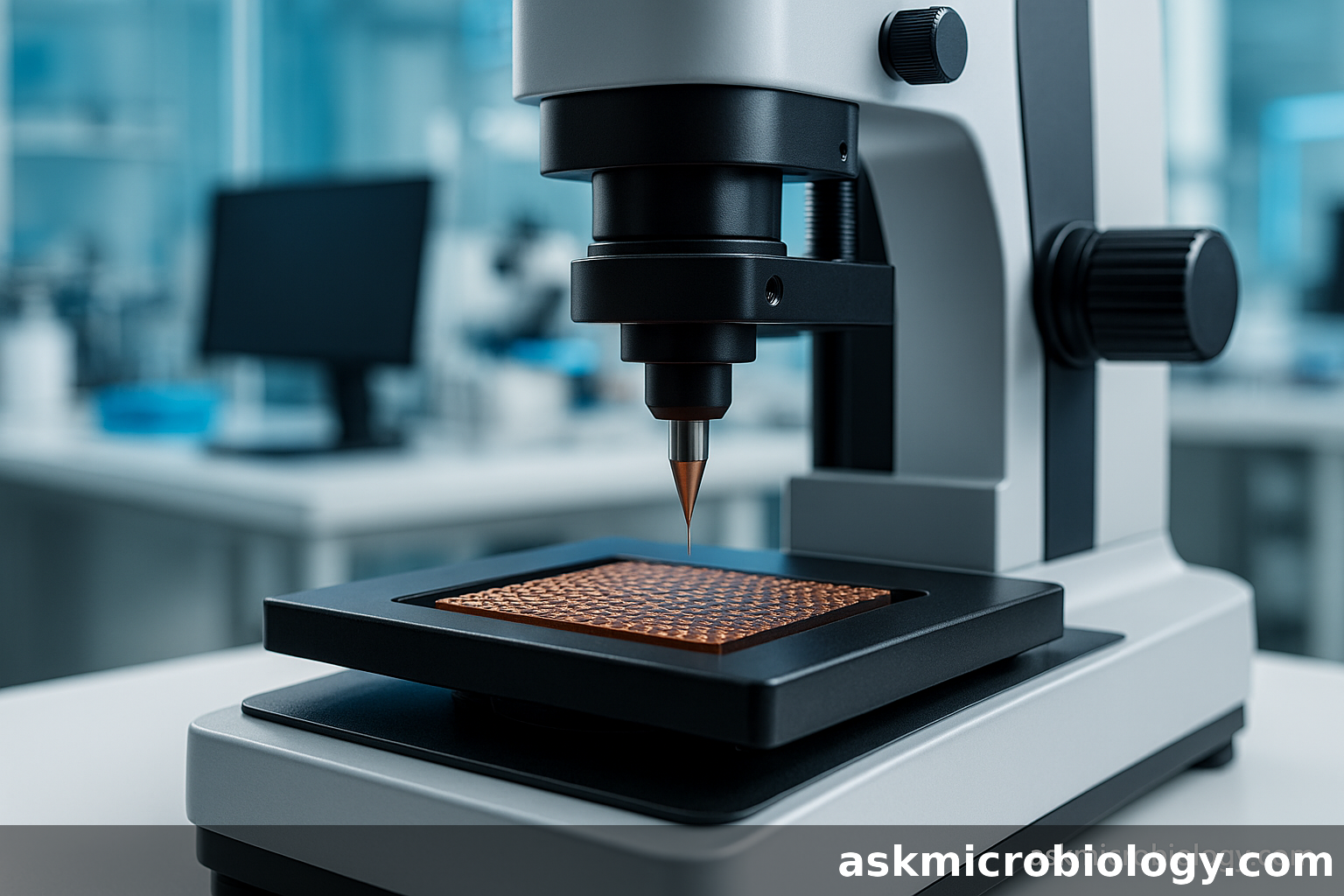
AtoAtomic Force Microscopy (AFM): Essential Parts and Their Functions Explained
!/images/posts/afmfeatured.png Principle of AFM Atomic Force Microscopy uses a nanometer‑scale cantilever tip to map surface topography with sub‑angstrom...

!https://askmicrobiology.com/wp-content/uploads/2025/06/photo1-22.jpgOverview The condenser is the heart of a light microscope’s illumination system, focusing...
!High-pressure autoclave releasing steam in a laboratory with digital controls, askmicrobiology.com watermark/images/posts/autoclavefeatured.png Why Consider...
Why Temperature Control Is Critical Microbial enzymes are exquisitely temperature‑dependent. A 2022 Applied and Environmental Microbiology study of 48 E. coli...
Introduction Snail shells often display striking protrusions known as knobs—tiny, calcified bumps that can transform an ordinary spiral into a rugged fortress....
Why Plate Preparation Quality Matters Contaminated or uneven agar plates can inflate false‑positive rates by 12–25 % CDC Lab Quality Report, 2023....
!Modern lab cell homogenizer breaking down cells in a tube on a lab bench/images/posts/cellhomogenizerfeatured.png Why Homogenization Matters Efficient cell...
Why Organization Matters in Microbiology According to the American Society for Microbiologyhttps://asm.org 2024 Laboratory Safety Survey, 78 % of sample...
What Makes the 4D Nucleofector Unique? The Lonza 4D platform combines electroporation with proprietary buffers to deliver plasmids directly into the nucleus....
!Olympus CH-2 microscope labeled diagram/images/posts/Microscopediagram-223x300.png Overview of the Olympus CH‑2 Series Released in the late 1980s, the...